
Loading...
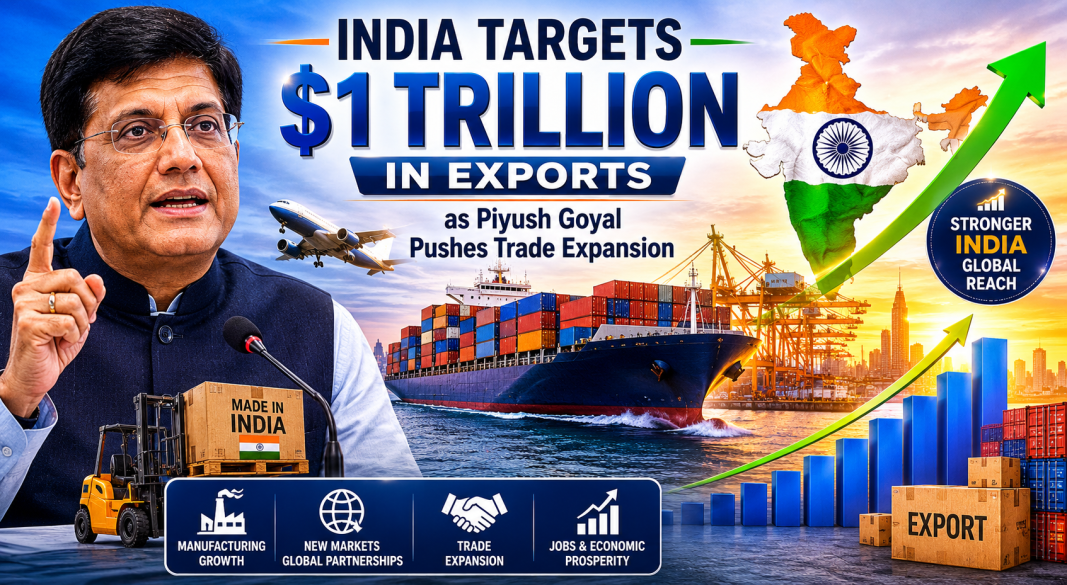
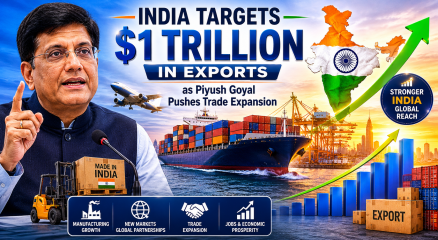
India has set an ambitious target of achieving $1 trillion in goods and services exports during the current financial year, Commerce and Industry Minister Piyush Goyal said, as the government steps up efforts to expand global market access and strengthen domestic manufacturing.
Speaking at industry events in New Delhi, Goyal said India’s exports reached a record $863 billion in the previous fiscal year despite geopolitical tensions and slowing global demand. The government now aims to bridge the remaining gap of about $137 billion through higher outbound shipments, new trade agreements and increased participation from Indian manufacturers.
The minister said both merchandise and services exports contributed to the growth, with services continuing to remain a major driver. He added that ongoing free trade agreements (FTAs) with several economies are expected to improve market access for Indian products by lowering import duties and easing trade barriers.
According to Goyal, India has either concluded or negotiated trade arrangements with nearly 38 developed countries over the last few years. Some agreements are expected to become operational in phases during the current fiscal year, including the proposed pact with Oman. Discussions are also underway with regions and countries such as the Gulf Cooperation Council, Canada, Israel and parts of Europe and Latin America.
The minister also urged Indian businesses to focus on import substitution by identifying products that are currently sourced from overseas but can be manufactured locally. He asked industries to closely monitor import trends and use the Commerce Ministry’s trade data platforms to identify opportunities for domestic production.
Industry and logistics stakeholders view the export target as a significant opportunity for the supply chain sector, which is expected to play a central role in handling higher cargo volumes and improving trade efficiency. Analysts say achieving the target will require stronger port infrastructure, faster customs clearances, expanded warehousing capacity and improved multimodal connectivity across manufacturing hubs.
The government has also highlighted ongoing reforms aimed at improving ease of doing business, including reduction of compliance burdens and digitisation of trade processes. Goyal said these measures, along with investments in logistics and industrial infrastructure, are intended to support exporters and improve India’s competitiveness in global markets.
Follow CARGOCONNECT for more updates.
India has set an ambitious target of achieving $1 trillion in goods and services exports during the current financial year, Commerce and Industry Minister Piyush Goyal said, as the government steps up efforts to expand global market access and strengthen domestic manufacturing. Speaking at industry events in New Delhi, Goyal said India’s exports reached a record $863 billion in the previous fiscal year despite geopolitical tensions and slowing global demand. The government now aims to bridge the remaining gap of about $137 billion through higher outbound shipments, new trade agreements and increased participation from Indian manufacturers. The minister said both merchandise and services exports contributed to the growth, with services continuing to remain a major driver. He added that ongoing free trade agreements (FTAs) with several economies are expected to improve market access for Indian products by lowering import duties and easing trade barriers. According to Goyal, India has either concluded or negotiated trade arrangements with nearly 38 developed countries over the last few years. Some agreements are expected to become operational in phases during the current fiscal year, including the proposed pact with Oman. Discussions are also underway with regions and countries such as the Gulf Cooperation Council, Canada, Israel and parts of Europe and Latin America. The minister also urged Indian businesses to focus on import substitution by identifying products that are currently sourced from overseas but can be manufactured locally. He asked industries to closely monitor import trends and use the Commerce Ministry’s trade data platforms to identify opportunities for domestic production. Industry and logistics stakeholders view the export target as a significant opportunity for the supply chain sector, which is expected to play a central role in handling higher cargo volumes and improving trade efficiency. Analysts say achieving the target will require stronger port infrastructure, faster customs clearances, expanded warehousing capacity and improved multimodal connectivity across manufacturing hubs. The government has also highlighted ongoing reforms aimed at improving ease of doing business, including reduction of compliance burdens and digitisation of trade processes. Goyal said these measures, along with investments in logistics and industrial infrastructure, are intended to support exporters and improve India’s competitiveness in global markets. Follow CARGOCONNECT for more updates.




India’s quick-commerce industry is still in an early stage of expansion, but Bengaluru has already emerged as the country’s most concentrated market for dark stores — the small urban warehouses that power rapid grocery and essentials delivery. According to recent industry estimates, India currently has an average of nearly 50 square feet of dark-store space for every 1,000 residents. Bengaluru stands far ahead of other cities with roughly 150 square feet per 1,000 people, underlining the city’s dominant position in the fast-delivery ecosystem. The sharp lead reflects Bengaluru’s high digital adoption, dense base of app-driven consumers and strong presence of major quick-commerce operators such as Blinkit, Zepto and Swiggy Instamart. Analysts say the city’s technology workforce and familiarity with online services have helped create consistent demand for deliveries within 10 to 15 minutes. Dark stores have become central to India’s quick-commerce race. Unlike conventional warehouses located on city outskirts, these facilities are positioned inside residential neighbourhoods to reduce delivery time. Most are compact fulfilment centres carrying fast-moving products and serving customers within a narrow radius. Industry observers note that the business model is now shifting from aggressive expansion to improving productivity at existing locations. Companies are focusing more on order density, inventory efficiency and faster turnaround rather than simply opening new facilities across cities. The rapid spread of dark stores is also beginning to reshape urban real estate patterns. Demand for small warehouse-style properties in residential pockets has increased, while rental values in some micro-markets have risen as quick-commerce companies compete for strategically located spaces. At the same time, the growth has triggered concerns around traffic congestion, rider safety and the impact on traditional neighbourhood retail. In several cities, residents have raised questions over the increasing conversion of commercial and mixed-use spaces into logistics hubs operating around the clock. Despite those concerns, experts believe India’s dark-store network still has significant room for growth. The relatively low national density compared with mature global quick-commerce markets suggests that companies will continue expanding deeper into urban and semi-urban regions over the next few years, particularly as consumer reliance on instant delivery services increases. Follow CARGOCONNECT for more such updates.
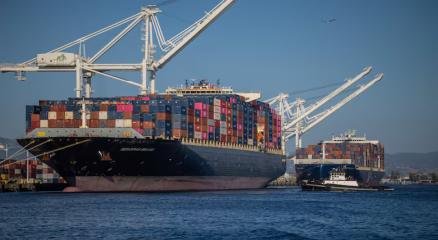


India is preparing to operationalise its trade agreement with Oman from June 1, as New Delhi accelerates efforts to secure alternative trade corridors and strengthen supply chain resilience amid continuing geopolitical and energy market uncertainty. Commerce and Industry Minister Piyush Goyal said discussions with Omani officials have progressed positively, with both sides moving toward implementation of the Comprehensive Economic Partnership Agreement (CEPA). The agreement, signed in December 2025, is expected to provide duty-free access for a large share of Indian exports to Oman, including engineering goods, textiles, food products and chemicals. In return, India will lower tariffs on several Omani exports, including petrochemical products and minerals. Trade and logistics stakeholders view the pact as strategically important for India’s westbound cargo movement and regional connectivity ambitions. Oman’s geographic position along major maritime routes in the Arabian Sea and Gulf region gives Indian exporters an additional gateway into West Asia and parts of Africa. The agreement is also expected to support warehousing, port-led trade and multimodal logistics integration between the two countries. Government officials indicated that the CEPA would cover more than 98% of Indian export tariff lines entering Oman, while India would gradually liberalise access across a significant portion of imports from Oman. Certain sectors, particularly petrochemicals, may see phased tariff reductions rather than immediate elimination. The push to activate the Oman pact comes as India expands its broader trade strategy through multiple bilateral agreements aimed at reducing dependence on concentrated supply chains and improving market access for domestic manufacturers. Recent discussions involving trade arrangements with the UK, EU and other partners have reinforced New Delhi’s emphasis on export diversification and trade-led industrial growth. Industry analysts expect the Oman agreement to particularly benefit Indian sectors linked to containerised exports, chemicals, automotive components, processed foods and MSME manufacturing clusters. Shipping and logistics companies are also likely to see increased cargo flows through western Indian ports as bilateral trade volumes rise under preferential tariff treatment. Follow CARGOCONNECT for more such updates.