
Loading...

The logistics and transportation infrastructure in Uttar Pradesh is steadily increasing, and a growing number of multimodal (multi-fare) connections are being developed to connect the eastern and western regions of the state. Major capital investments into expressways, freight corridors, airports and logistics parks are leading to the recent expansion.
LEADS 2025 has ranked the State of Uttar Pradesh in the 'Exemplar' category this year. This indicates that Uttar Pradesh has a relatively strong level of performance - at or above the average performance levels for other states that are landlocked - on all of the LEADS 2025 Infrastructure Metrics: infrastructure metrics, logistics services metrics, regulatory metrics, and digital systems metrics. In addition, there are some specific metrics contained within this report indicating that Uttar Pradesh has been able to outperform all of the other landlocked states on a number of specific metrics.
The construction of multiple expressways has been completed or is well on its way to being completed to enhance road access and connection between the National Capital Region (NCR) and key areas of Uttar Pradesh (i.e. Agra-Lucknow, Purvanchal, Bundelkhand, Gorakhpur Link, and Yamuna). Therefore, significant reductions in the time that it takes for goods to move through the state and access key points of commerce, such as industrial centres.
Likewise, rail-based freight movement will be substantially enhanced through the Eastern and Western Dedicated Freight Corridors, both of which are expected to provide the infrastructure required for long-distance freight movement and improve capacity within existing rail infrastructure in the state.
The Greater Noida Dadri multimodal logistics hub, now under development, is expected to provide a large degree of cargo handling and warehousing capacity, while there are multiple additional logistics parks in Boraki, Kanpur, Gorakhpur, and forecasted from Tappal-Bajna.
The Noida International Airport (Jewar) is also being established as a cargo/aviation hub with expected road and rail connectivity to facilitate freight moving in and out. Additionally, additional inland waterways infrastructure has also been developed, including the Varanasi Multimodal Terminal, as part of the larger logistics network in the region.
There is currently considerable development occurring in the agriculture sector, including cold storage/warehousing/distribution for perishable products, along with dedicated storage infrastructure for e-commerce, retail and food processing.
To facilitate and speed up the approval process and improve coordination between departments, policies such as the ‘Nivesh Mitra’ single-window system and the use of GIS-based planning tools have been put in place. Business development representatives have stated that these changes have led to an increase in the number of investment proposals for logistics and warehousing, but have further stated that the current rate of implementation and completion is a key issue. Analysts indicate that the overall improvement of infrastructure has substantially improved overall connectivity and logistics capacity, but predict that the degree of improvement
For more such news and updates, visit CARGOCONNECT.

The Centre has decided to proceed with a new ₹13,000-crore greenfield civil-military airport in Great Nicobar Island, abandoning long-standing plans to expand the Indian Navy’s INS Baaz air station. The move marks a significant shift in India’s infrastructure strategy for the strategically located island in the eastern Indian Ocean. According to government and defence sources, the proposed dual-use airport will be developed at Chingen near Galathea Bay and will cater to both civilian and military operations. The facility forms a key component of the broader Great Nicobar Island Development Project, which carries an estimated investment of around ₹81,000 crore and includes a transshipment port, power infrastructure and township development. The decision effectively ends proposals to extend the runway at INS Baaz in Campbell Bay. Studies conducted over the past several years reportedly found that expanding the existing naval airfield would be technically challenging due to terrain constraints, navigational limitations and the requirement for substantial supporting infrastructure. Located close to the Malacca Strait, one of the world’s busiest maritime trade routes, the new airport is expected to strengthen India’s logistics capabilities, improve connectivity to the remote island territory and support military operations in the Indo-Pacific region. Defence officials have indicated that the airport will remain under naval operational control while also serving civilian aviation requirements. Construction is expected to be completed within five years. The airport project is part of the government’s broader effort to develop Great Nicobar as a strategic and economic hub. Authorities argue that the new facility will enhance surveillance, maritime domain awareness, disaster-response capabilities and logistical reach across the Andaman and Nicobar archipelago. However, the wider Great Nicobar development programme continues to face scrutiny from environmental groups and opposition leaders, who have raised concerns about its potential impact on rainforests, coral ecosystems and indigenous communities. Critics have questioned whether the economic and strategic benefits outweigh the environmental costs associated with large-scale infrastructure development on the ecologically sensitive island. Despite the debate, the government maintains that the project is essential for strengthening India’s strategic presence in the Indian Ocean region while improving connectivity and economic opportunities in one of the country’s most remote territories. Follow CARGOCONNECT for more such updates

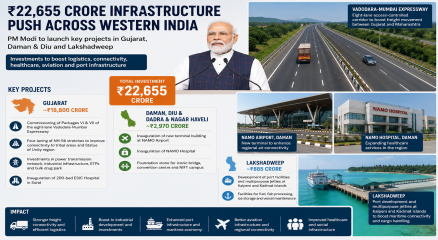
Prime Minister Narendra Modi is set to inaugurate and lay the foundation stone for infrastructure projects worth ₹22,655 crore across Gujarat, Dadra and Nagar Haveli and Daman and Diu, and Lakshadweep, with investments concentrated in transport, maritime infrastructure, healthcare, aviation and industrial development. The projects are expected to strengthen freight connectivity, improve logistics efficiency and support economic activity across key manufacturing, coastal and island regions. The largest share of the investment, estimated at around ₹18,800 crore, is earmarked for Gujarat. Among the key projects is the commissioning of Packages VI and VII of the eight-lane Vadodara-Mumbai Expressway, a strategic freight corridor that will enhance connectivity between Gujarat and Maharashtra, two of India's largest industrial and logistics hubs. The government will also launch the four-laning of critical stretches of National Highway-56 to improve access to tribal districts and strengthen road connectivity to the Statue of Unity region. In Daman, projects worth approximately ₹2,970 crore will focus on aviation, healthcare and urban infrastructure. The programme includes the inauguration of the new terminal building at NAMO Airport and the commissioning of NAMO Hospital. Foundation stones will also be laid for an iconic bridge, a convention centre and a National Institute of Fashion Technology (NIFT) campus, aimed at supporting regional development and investment. Lakshadweep will receive infrastructure investments worth about ₹885 crore, primarily focused on maritime connectivity. The projects include the development of port facilities and multipurpose jetties at Kalpeni and Kadmat islands. The new facilities are designed to accommodate large passenger and cruise vessels while improving cargo handling capacity and supporting fisheries-related activities. Associated infrastructure will include facilities for fuel supply, fish processing, ice storage and vessel maintenance. From a logistics perspective, the investment package reflects a continued focus on multimodal connectivity across western India. The combination of expressway expansion, port infrastructure development, airport upgrades and industrial utility projects is expected to improve supply chain efficiency, facilitate cargo movement and strengthen links between manufacturing centres, ports and consumption markets. The projects form one of the largest infrastructure investment programmes announced this year for western India and the island territories, with a strong emphasis on transport networks, industrial competitiveness and regional connectivity. Follow CARGOCONNECT for more such updates.


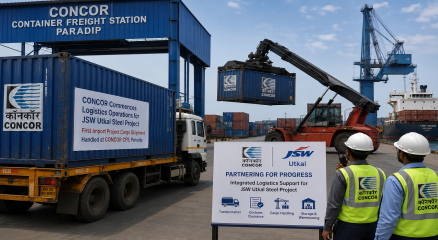
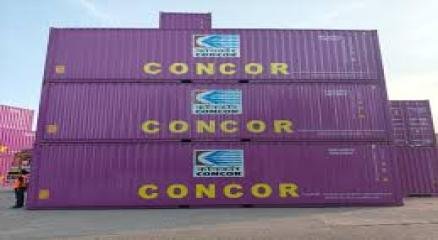
Container Corporation of India Ltd. (CONCOR) has commenced logistics operations for JSW Utkal’s upcoming steel manufacturing facility, handling the first import project cargo shipment linked to the project. The initial consignment, processed through CONCOR’s Container Freight Station (CFS) at Paradip, consisted of 25 forty-foot containers carrying project cargo required for the steel plant’s development. The movement was executed under the company’s integrated logistics service model, covering transportation, customs clearance, cargo handling and storage. According to the company, the operation included first and last-mile transportation, warehousing support, container freight station handling, and coordination with port authorities, shipping lines and customs officials. The shipment marks the beginning of logistics support activities for the large-scale industrial project. Industry estimates indicate that cargo volumes associated with the JSW Utkal project could reach nearly 1,000 forty-foot containers over the next two years as construction and equipment imports accelerate. The successful handling of the maiden shipment positions CONCOR as a key logistics partner for the project, with responsibilities expected to extend across cargo movement, storage and supply chain coordination during the plant’s development phase. The engagement also highlights the growing role of Paradip as a logistics gateway for heavy industrial and infrastructure projects in eastern India, supported by increasing demand for integrated cargo handling and warehousing services. Follow CARGOCONNECT for more such updates.