
Loading...

Pradeep Panicker has been appointed Chief Executive Officer of Delhi International Airport, marking a leadership transition at one of India’s busiest aviation and cargo hubs. He moves into the role after serving as CEO of GMR Hyderabad International Airport since 2020.
Panicker brings more than two decades of experience across airport operations, commercial development, aviation infrastructure and project finance. His appointment comes at a time when Delhi Airport is expanding passenger services, strengthening cargo operations and investing in technology-driven infrastructure upgrades.
Before leading Hyderabad Airport, Panicker held several senior positions within the GMR Group, including commercial and operational leadership roles at Delhi Airport. During his earlier tenure at the airport, he was involved in airline business development, cargo-related commercial activities and land development projects linked to the airport ecosystem.
The leadership change comes as Delhi International Airport continues to focus on operational efficiency and infrastructure modernisation. In recent months, the airport operator has introduced advanced weather-monitoring systems aimed at reducing disruptions caused by fog and adverse weather conditions. The airport has also moved ahead with plans to strengthen cargo terminal operations through new long-term management and development initiatives.
Delhi Airport remains a critical gateway for both passenger and freight movement, handling more than 1,300 flight movements daily and serving as a major node in India's air cargo network. Panicker’s appointment is expected to support the airport’s ongoing focus on capacity enhancement, cargo handling efficiency and technology-led operational improvements as competition among major Indian aviation hubs continues to intensify.
Follow CARGOCONNECT for more such updates.

Pradeep Panicker has been appointed Chief Executive Officer of Delhi International Airport, marking a leadership transition at one of India’s busiest aviation and cargo hubs. He moves into the role after serving as CEO of GMR Hyderabad International Airport since 2020. Panicker brings more than two decades of experience across airport operations, commercial development, aviation infrastructure and project finance. His appointment comes at a time when Delhi Airport is expanding passenger services, strengthening cargo operations and investing in technology-driven infrastructure upgrades. Before leading Hyderabad Airport, Panicker held several senior positions within the GMR Group, including commercial and operational leadership roles at Delhi Airport. During his earlier tenure at the airport, he was involved in airline business development, cargo-related commercial activities and land development projects linked to the airport ecosystem. The leadership change comes as Delhi International Airport continues to focus on operational efficiency and infrastructure modernisation. In recent months, the airport operator has introduced advanced weather-monitoring systems aimed at reducing disruptions caused by fog and adverse weather conditions. The airport has also moved ahead with plans to strengthen cargo terminal operations through new long-term management and development initiatives. Delhi Airport remains a critical gateway for both passenger and freight movement, handling more than 1,300 flight movements daily and serving as a major node in India's air cargo network. Panicker’s appointment is expected to support the airport’s ongoing focus on capacity enhancement, cargo handling efficiency and technology-led operational improvements as competition among major Indian aviation hubs continues to intensify. Follow CARGOCONNECT for more such updates.



Egypt is poised for significant aviation growth over the coming years, supported by strategic geography, infrastructure investment, and rising demand for passenger and cargo connectivity, according to the International Air Transport Association (IATA). The association believes the country is well positioned to strengthen its role as a regional air transport and logistics gateway linking Africa, the Middle East, and Europe. IATA highlighted the country’s ongoing airport modernization efforts, expanding airline networks, and growing importance in global supply chains. Egypt’s location along major international trade corridors and proximity to the Suez Canal continue to provide a competitive advantage for both passenger and cargo operations. The sector is increasingly viewed as a critical contributor to trade facilitation, tourism recovery, and economic diversification. Cairo International Airport remains central to Egypt’s aviation ambitions. The airport has undergone substantial upgrades in recent years, including expanded terminal capacity, improved baggage systems, and enhanced airside infrastructure to accommodate growing traffic volumes and larger aircraft. These investments are expected to improve operational efficiency and strengthen Egypt’s position as a regional transit hub. The aviation industry’s recovery after the pandemic has also accelerated opportunities for air cargo and logistics providers operating in the region. Industry observers note that rising e-commerce demand, pharmaceutical shipments, and time-sensitive cargo movements are increasing the importance of reliable air freight connectivity across Africa and the Middle East. Egypt’s expanding aviation ecosystem is therefore becoming increasingly relevant for global supply chain networks. National carrier EgyptAir and private operators such as Nile Air are continuing to expand regional connectivity, supporting passenger mobility and cargo throughput. EgyptAir currently serves more than 75 destinations globally, while Nile Air is strengthening services across the Middle East, Africa, and parts of Europe. IATA also emphasized the importance of policy alignment and industry collaboration to sustain long-term growth. Areas such as airport capacity development, digitalization, operational efficiency, sustainability, and workforce training will be essential as Egypt aims to capture increasing aviation demand across the region. The association continues to advocate for harmonized regulations and investments that enhance connectivity while improving resilience across the air transport value chain. Beyond tourism, aviation is expected to play a larger role in supporting Egypt’s broader logistics and trade ambitions. With multinational manufacturers and distributors increasingly seeking alternative regional hubs, Egypt could benefit from its multimodal connectivity combining air, maritime, and land transport infrastructure. Analysts believe this integrated approach may help position the country as a preferred gateway for cargo flows into Africa and surrounding markets. As global air traffic continues its upward trajectory, IATA’s assessment signals growing confidence in Egypt’s ability to emerge as a stronger player in international aviation and logistics. Continued investment, infrastructure modernization, and strategic partnerships are likely to determine how effectively the country converts this potential into sustained long-term growth. 𝐒𝐭𝐚𝐲 𝐓𝐮𝐧𝐞𝐝 𝐭𝐨 https://cargoconnect.co.in/ 𝐟𝐨𝐫 𝐥𝐚𝐭𝐞𝐬𝐭 𝐮𝐩𝐝𝐚𝐭𝐞𝐬!



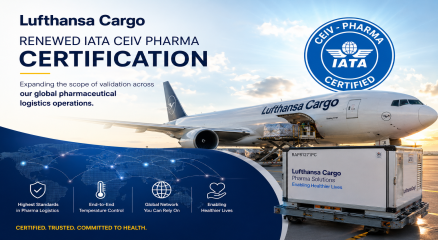
Lufthansa Cargo has received renewed certification from the International Air Transport Association (IATA) under the CEIV Pharma standard, expanding the scope of validation to include a broader review of its global pharmaceutical logistics operations. The certification, valid through April 2029, covers both Lufthansa Cargo’s airline processes and its wider corporate quality management framework for handling temperature-sensitive healthcare shipments. The latest audit also assessed the carrier’s centralized oversight and operational consistency across parts of its international network. The CEIV Pharma programme is designed to verify compliance with industry standards for transporting pharmaceutical and life science products by air. Lufthansa Cargo said the updated certification includes its pharma hubs in Frankfurt, Munich and Chicago, along with stations in Atlanta, Washington D.C., Mexico City and New York. Brendan Sullivan, IATA’s Global Head of Cargo, said the certification demonstrated how “standardized processes, centralized governance and local execution go hand in hand across the entire network.” Oliver von Götz, Vice President Global Fulfillment Management at Lufthansa Cargo, said the company had continued investing in pharmaceutical logistics capabilities through process improvements, infrastructure upgrades and employee training. Lufthansa Cargo first obtained CEIV Pharma certification in 2016 and has maintained the accreditation for ten consecutive years. The company currently operates more than 350 cargo stations worldwide, including around 230 stations offering passive temperature support and approximately 120 equipped for active temperature-controlled handling. The certification comes as pharmaceutical airfreight continues to grow in importance for global carriers, driven by demand for secure and temperature-controlled transportation of vaccines, biologics and other sensitive healthcare products. Follow CARGOCONNECT for more such updates.