
Loading...
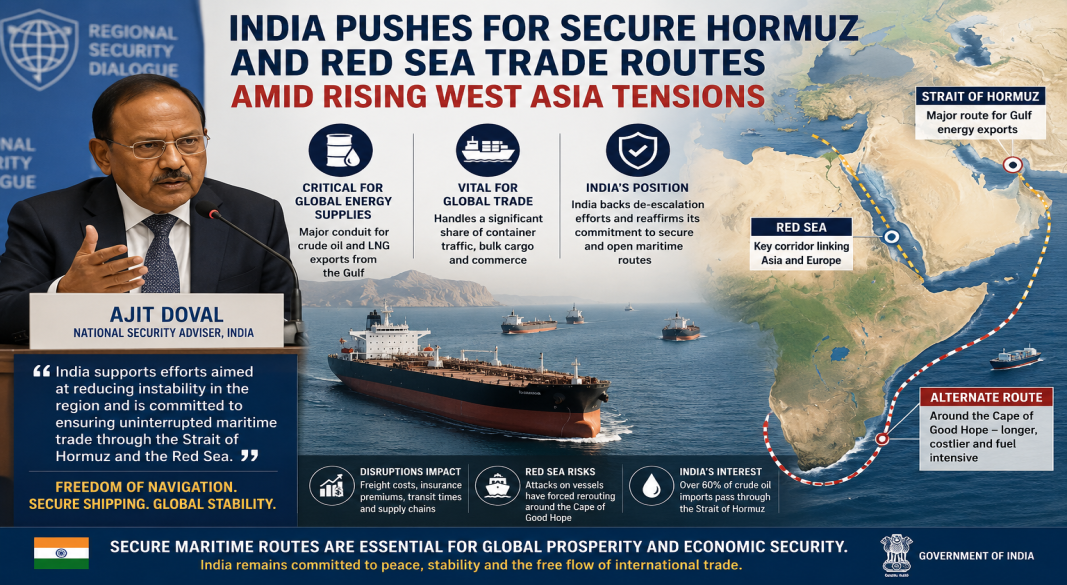
India’s National Security Adviser Ajit Doval has called for uninterrupted maritime trade through the Strait of Hormuz and the Red Sea, underscoring the strategic importance of both routes for global energy supplies and international commerce as geopolitical tensions continue to disrupt shipping movements across West Asia.
Speaking during a regional security dialogue, Doval said India supports efforts aimed at reducing instability in the region and reaffirmed New Delhi’s willingness to contribute constructively toward de-escalation initiatives. His remarks come at a time when attacks on commercial vessels and heightened military activity have increased operational risks for shipping companies using key maritime corridors.
The Strait of Hormuz and the Red Sea remain among the world’s most critical trade chokepoints, handling a substantial share of global crude oil exports, container traffic and bulk cargo flows. Any prolonged disruption in these routes has direct implications for freight costs, insurance premiums, transit schedules and supply chain reliability, particularly for energy-importing economies such as India.
Industry analysts note that uncertainty in West Asia has already forced several shipping operators to reassess routing strategies, with some carriers diverting vessels around the Cape of Good Hope to avoid security threats in the Red Sea. The alternative route significantly increases voyage duration, fuel consumption and operating expenses, placing additional pressure on global logistics networks.
For India, uninterrupted access through the Strait of Hormuz is especially critical as a large portion of the country’s crude oil and liquefied natural gas imports originate from Gulf producers. Disruptions in the region could impact energy procurement costs and downstream industrial supply chains.
Doval’s statement reflects India’s broader diplomatic and economic interest in maintaining stability across major maritime trade lanes that connect Asia, Europe and the Middle East. The government has consistently emphasised freedom of navigation and secure commercial shipping as essential components of regional economic security.
Shipping and logistics stakeholders have been closely monitoring developments in the Red Sea since attacks on merchant vessels intensified over recent months. The disruptions have contributed to higher container freight rates, vessel delays and increased war-risk insurance charges across several trade corridors linking Asia with Europe.
Despite the volatile environment, India has continued diplomatic engagement with regional partners while maintaining a focus on safeguarding trade continuity and maritime security. Analysts say the country’s position highlights growing concern among major trading nations over the wider economic consequences of instability in strategic shipping corridors.
Follow CARGOCONNECT for more such updates.
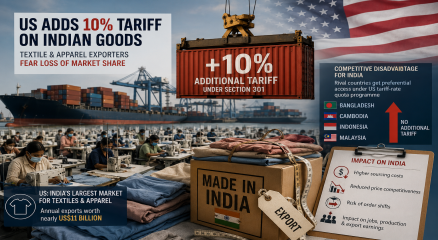
Indian textile and apparel exporters could lose market share in the United States after Washington imposed an additional 10% tariff on a broad range of Indian goods, according to the Confederation of Indian Textile Industry (CITI). The industry body has warned that the measure places Indian suppliers at a competitive disadvantage against several Asian manufacturing hubs that have secured preferential treatment under the new US trade framework. The tariff, introduced under Section 301 of the US Trade Act of 1974, comes on top of existing most-favoured-nation import duties and applies to a significant portion of India's manufactured exports, including textiles and apparel. Industry representatives say the additional levy is likely to increase sourcing costs for US buyers and reduce the price competitiveness of Indian products. CITI said the competitive imbalance has been intensified by the exclusion of India from a new tariff-rate quota programme that allows eligible textile and apparel shipments from countries such as Bangladesh, Cambodia, Indonesia and Malaysia to enter the US market without the additional Section 301 duty, provided they use US-origin cotton and fibre. The industry body believes this could encourage global retailers and brands to shift sourcing away from India. The United States remains India's largest overseas market for textile and apparel exports, with annual shipments valued at nearly US$11 billion. Any decline in demand from US buyers could have implications for manufacturing activity, employment and export earnings across India's textile supply chain, industry participants said. Trade analysts also expect the tariff's impact to extend beyond textiles. According to estimates by the Global Trade Research Initiative, around 70% of India's exports to the US—including garments, machinery, chemicals, plastics, leather products, gems and jewellery, and furniture—are expected to face the additional levy alongside existing import duties. The US tariff measures were introduced as part of a broader trade action targeting imports from multiple countries over concerns related to the enforcement of forced-labour import restrictions. While several product categories remain exempt, the new duties cover the majority of manufactured goods entering the US market. As of the latest reports, India's Ministry of Commerce and Industry had not issued an official response to the industry's concerns. Exporters are expected to closely monitor the implementation of the new tariff regime and assess its impact on order flows and sourcing decisions in the coming months. Follow CARGOCONNECT for more such updates.

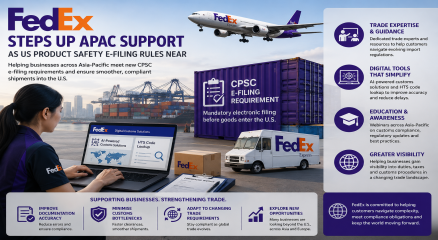
FedEx is expanding its support for businesses across the Asia-Pacific region as exporters prepare for the United States' mandatory Consumer Product Safety Commission (CPSC) electronic filing requirements, aiming to help customers meet new compliance obligations and reduce customs-related disruptions. The logistics company said it is strengthening its trade compliance resources, digital customs capabilities and customer guidance as the new U.S. product safety filing framework approaches. The move is intended to help exporters navigate evolving import regulations while maintaining smoother cross-border shipments into the U.S. market. Under the new CPSC e-filing regime, importers will be required to submit product safety certificate data electronically through U.S. customs systems before goods enter the country. The requirement is expected to increase documentation standards for manufacturers, exporters and logistics providers handling regulated consumer products. To support customers, FedEx is offering trade expertise alongside digital tools designed to simplify customs documentation and improve shipment accuracy. These include AI-powered customs solutions and a Harmonized Tariff Schedule (HTS) code lookup feature that assists shippers in selecting the correct tariff classifications, reducing the risk of clearance delays caused by inaccurate declarations. The company has also expanded educational initiatives across Asia-Pacific, conducting customer webinars focused on customs compliance, regulatory updates and best practices for managing cross-border shipments. According to FedEx, the sessions have attracted thousands of participants from small and medium-sized enterprises as well as multinational companies, reflecting growing demand for guidance amid changing trade regulations. FedEx noted that businesses are increasingly seeking greater visibility into duties, taxes and customs procedures as trade policies continue to evolve. Survey feedback gathered during the webinar programme showed that regulatory changes remain one of the biggest challenges for companies engaged in international trade, while many businesses are also exploring opportunities beyond the U.S., particularly within Asia and Europe. The company said its expanded compliance support is aimed at helping customers improve documentation accuracy, minimise customs bottlenecks and adapt to changing international trade requirements as cross-border supply chains become more complex. Follow CARGOCONNECT for more such updates.
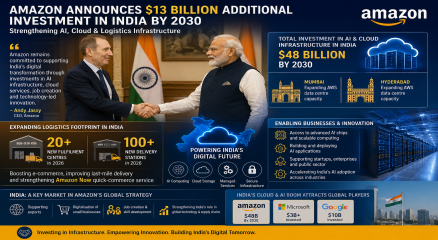
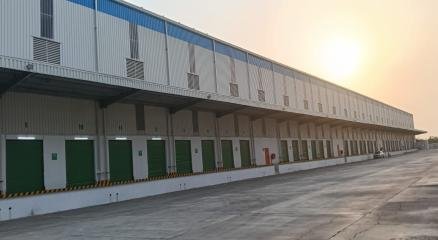
Amazon has announced an additional investment of $13 billion in India by 2030 to strengthen its artificial intelligence (AI), cloud computing and logistics infrastructure, reinforcing the country's position as a key market in the company's long-term global strategy. The fresh commitment will be directed toward expanding Amazon Web Services' (AWS) data centre capacity in Mumbai and Hyderabad, enabling businesses, startups and public sector organisations to access advanced AI computing, cloud storage and managed technology services. The latest investment increases Amazon's planned spending on AI and cloud infrastructure in India to $48 billion by the end of the decade. Alongside its cloud expansion, Amazon plans to significantly grow its logistics footprint across the country. The company intends to add more than 20 fulfilment centres and over 100 delivery stations during 2026, supporting rising e-commerce demand while improving order processing and last-mile delivery capabilities. The expansion is also expected to strengthen Amazon's quick-commerce service, Amazon Now, as it targets a wider presence across Indian cities. The announcement came during Amazon Chief Executive Officer Andy Jassy's visit to New Delhi, where he met Prime Minister Narendra Modi. Jassy said the company remains committed to supporting India's digital transformation through investments in AI infrastructure, cloud services, job creation and technology-led innovation. Amazon said its expanded infrastructure will help organisations develop and deploy AI applications more efficiently while providing access to specialised AI chips, scalable computing resources and secure cloud platforms. The company expects these investments to support enterprises across sectors as AI adoption accelerates. The investment also reflects increasing competition among global technology companies in India's cloud and AI market. Major players including Microsoft and Google have announced multi-billion-dollar commitments to expand digital infrastructure in the country, driven by growing enterprise demand and government initiatives promoting digital services. Amazon said its broader investment strategy in India also includes support for exports, digitalisation of small businesses and employment generation, underscoring the country's growing importance in the global technology and supply chain ecosystem. Follow CARGOCONNECT for more such updates.