
Loading...

China has strengthened its economic and strategic presence in the Bay of Bengal after Bangladesh signed an agreement to develop an industrial and economic zone near Mongla Port, replacing a project that had previously been allocated to India. The agreement marks another step in Beijing's expanding infrastructure footprint across the Indian Ocean while highlighting Dhaka's evolving foreign investment priorities.
The agreement was formalised during Bangladeshi Prime Minister Tarique Rahman's official visit to Beijing, where he held talks with Chinese President Xi Jinping. Under the deal, a Chinese state-owned enterprise will develop the economic zone adjacent to Mongla Port, Bangladesh's second-largest seaport after Chattogram. The land had initially been earmarked for an India-backed project before Bangladesh's interim government removed it from the proposal in 2025 following a deterioration in bilateral relations.
For the logistics and maritime sector, the project significantly enhances China's access to one of the Bay of Bengal's key commercial gateways. Mongla Port serves as an important hub for cargo movement into southwestern Bangladesh and provides connectivity to regional shipping routes. The development is expected to support manufacturing, warehousing and export-oriented industries while strengthening the port's role in regional supply chains.
The agreement also aligns with China's broader strategy of investing in maritime infrastructure across the Indian Ocean. Beijing has financed or developed port-linked projects stretching from Pakistan's Gwadar Port to facilities in East Africa, expanding commercial networks that complement its global trade ambitions. Analysts say the addition of Mongla further reinforces China's logistics presence in South Asia, although the project remains a commercial infrastructure investment at this stage.
Beyond the Mongla project, Bangladesh and China agreed to accelerate work on the Chinese Economic and Industrial Zone in Chattogram while expanding cooperation in water resource management, including the proposed Teesta River restoration initiative. The two governments also outlined plans to deepen collaboration in digital technologies, artificial intelligence, green development, agriculture, trade, maritime affairs and investment.
The joint understanding reflects Bangladesh's efforts to attract large-scale foreign investment to support industrial growth and logistics infrastructure. For China, the agreements reinforce long-term economic engagement with a country strategically positioned along key maritime trade corridors connecting South Asia with Southeast Asia and the wider Indian Ocean.
The shift is likely to be closely watched by India, which had originally been expected to participate in the Mongla economic zone project. While the latest agreement does not alter the commercial status of the port, it underscores the growing competition among regional powers to secure infrastructure partnerships that influence future trade flows, manufacturing investment and supply chain connectivity across the Bay of Bengal.
Follow CARGOCONNECT for more such updates.
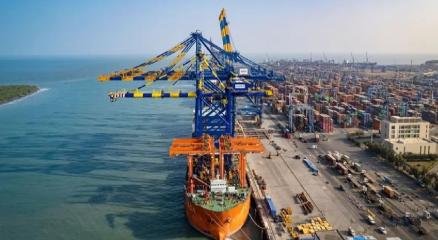
Kerala’s Vizhinjam International Seaport has achieved a significant milestone by handling its 1,000th commercial vessel in less than two years since commencing operations, reinforcing its emergence as one of the world’s fastest-growing container transshipment hubs. The landmark was marked with the arrival of the container vessel MSC Luciana, highlighting the port’s rapid operational growth and increasing relevance in global shipping networks. Developed as India’s first deep-water automated transshipment port, Vizhinjam has witnessed remarkable progress since receiving its first commercial vessel. Its strategic location, just 10 nautical miles from one of the world’s busiest east-west international shipping routes, has enabled the port to attract major container lines and large mother vessels that traditionally relied on foreign transshipment hubs. Industry experts believe the achievement reflects growing confidence among global shipping companies in the port’s infrastructure and operational capabilities. Featuring a natural deep draft of around 20 metres, advanced cargo-handling equipment and modern terminal systems, Vizhinjam is capable of handling some of the world’s largest container ships with minimal turnaround time. The 1,000-vessel milestone also underscores India’s broader ambition to strengthen domestic transshipment capacity and reduce dependence on overseas ports for container movement. By offering direct access to international shipping routes, the port is expected to improve supply chain efficiency, lower logistics costs and enhance India's competitiveness in maritime trade. Since commercial operations began, vessel traffic at Vizhinjam has steadily increased, supported by growing cargo volumes and regular calls from leading global shipping lines. The port’s ability to accommodate ultra-large container vessels has positioned it as a preferred gateway for regional and international cargo movement. The milestone is expected to further accelerate investments in port-led infrastructure, logistics parks, warehousing and multimodal connectivity across Kerala and southern India. As additional phases of development progress, Vizhinjam is projected to significantly expand its container handling capacity and strengthen its role as a strategic logistics gateway for the Indian subcontinent. For India's supply chain ecosystem, the port's rapid rise signals the growing importance of world-class maritime infrastructure in supporting international trade. With its strategic advantages and continued expansion, Vizhinjam is poised to play a pivotal role in reshaping regional cargo flows and establishing India as a stronger player in global maritime logistics. 𝐒𝐭𝐚𝐲 𝐓𝐮𝐧𝐞𝐝 𝐭𝐨 CARGOCONNECT 𝐟𝐨𝐫 𝐥𝐚𝐭𝐞𝐬𝐭 𝐮𝐩𝐝𝐚𝐭𝐞𝐬!

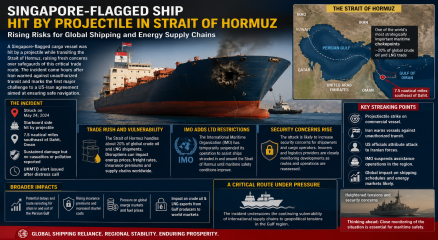
A Singapore-flagged cargo vessel was struck by a projectile while transiting the Strait of Hormuz, escalating concerns over the security of one of the world's busiest maritime trade corridors and raising fresh risks for global shipping and energy supply chains. The incident marks the first major challenge to a recently announced US-Iran agreement aimed at restoring safe commercial navigation through the strategic waterway. According to maritime security officials, the vessel was hit on its starboard side about 7.5 nautical miles southeast of Dahit, Oman, while sailing through a United Nations-backed transit route. The ship sustained damage but there were no reported casualties or signs of pollution. The United Kingdom Maritime Trade Operations (UKMTO) issued an alert after receiving the distress report. Two US officials told Reuters that Iranian forces were responsible for the attack, although Tehran had not publicly commented on the allegations at the time of reporting. The strike came hours after Iranian authorities warned commercial vessels against using designated transit routes without prior permission from Tehran. The attack has prompted the International Maritime Organization (IMO) to temporarily suspend its operation to assist ships stranded in and around the Strait of Hormuz until maritime safety conditions improve. The decision could delay the movement of vessels waiting to exit the Gulf, adding further pressure on regional shipping operations. The Strait of Hormuz remains one of the world's most strategically important maritime chokepoints, handling a substantial share of global crude oil and liquefied natural gas shipments. Any disruption to commercial traffic through the passage has the potential to affect freight schedules, insurance premiums, vessel routing decisions and global energy markets. Industry analysts said the latest incident is likely to increase security concerns for shipowners and cargo operators using the route, with insurers and logistics providers expected to closely monitor developments before normal shipping activity resumes. The attack underscores the continuing vulnerability of international supply chains to geopolitical tensions in the Gulf region. Follow CARGOCONNECT for more such updates.

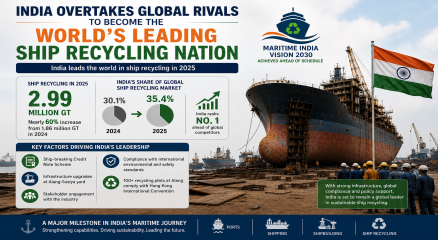
India has emerged as the world's largest ship recycling nation in 2025, achieving a milestone originally targeted under the Maritime India Vision 2030 well ahead of schedule. According to the latest data from the United Nations Conference on Trade and Development (UNCTAD), the country recycled 2.99 million gross tonnes (GT) of ships during the year, a nearly 60% increase from 1.86 million GT recorded in 2024. The increase has elevated India's share of the global ship recycling market to 35.4%, up from 30.1% a year earlier, placing the country ahead of traditional market leaders in the sector. Government officials attributed the growth to a combination of regulatory reforms, infrastructure upgrades and policy measures aimed at strengthening the domestic ship recycling ecosystem. Key initiatives include the Ship-breaking Credit Note Scheme, improvements at the Alang-Sosiya ship recycling yard, stakeholder engagement with the industry, and compliance with international environmental and safety standards. The Alang-Sosiya recycling cluster in Gujarat remains the centre of India's ship dismantling industry, accounting for the overwhelming majority of the country's recycling activity. More than 100 recycling plots at the facility now comply with the Hong Kong International Convention for the Safe and Environmentally Sound Recycling of Ships, reflecting India's focus on sustainable recycling practices. The achievement represents an important benchmark for India's broader maritime strategy, which seeks to expand the country's capabilities across ports, shipping, shipbuilding and recycling while increasing its role in global maritime trade. Earlier government policy documents had identified leadership in ship recycling as a key objective to be achieved by 2030. Industry observers expect global ship recycling demand to remain strong over the coming years as ageing fleets are retired and environmental regulations encourage vessel replacement. India's established infrastructure, growing compliance with international standards and policy support are expected to strengthen its competitive position in the global recycling market. Follow CARGOCONNECT for more such updates.