
Loading...
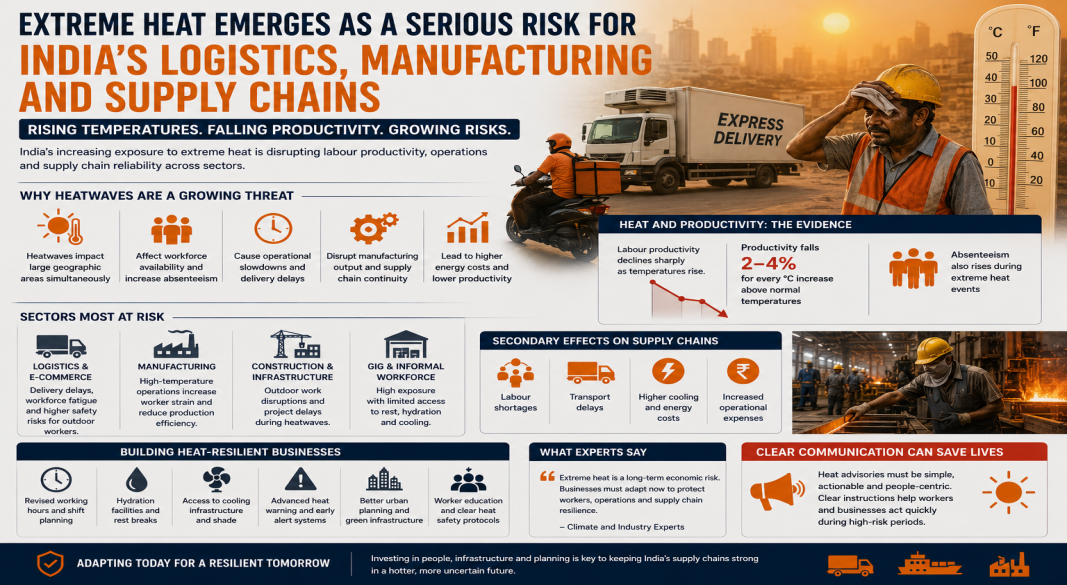
India’s rising exposure to extreme heat and dangerous condition is emerging as a serious risk for the country’s logistics, manufacturing and supply chain sectors, with climate experts warning of long-term economic disruption driven by falling labour productivity and operational slowdowns.
Industry experts and climate researchers say the impact of heatwaves is no longer limited to seasonal discomfort. Instead, prolonged exposure to high temperatures is beginning to affect workforce availability, delivery timelines, factory output and urban mobility systems across India.
The concern is especially significant for labour-intensive industries that depend heavily on outdoor and semi-outdoor operations. Logistics companies, e-commerce platforms and manufacturing firms are increasingly being forced to adjust work schedules, introduce heat safety measures and prepare contingency plans during periods of extreme weather.
Climate specialists note that heatwaves differ from floods and other localised disasters because they affect large geographic regions simultaneously. This broad exposure increases the risk of widespread disruption across interconnected supply chains, particularly in densely populated industrial corridors.
The manufacturing sector is considered particularly vulnerable. Steel plants, engineering units, textile factories and other heat-intensive facilities face additional pressure because workers are already exposed to high-temperature environments created by furnaces, boilers and industrial machinery.
Supply chain operators are also confronting secondary effects such as labour shortages, transport delays and higher cooling and energy costs. Recruitment firms and corporate executives have reported increasing challenges in maintaining workforce continuity during severe heatwaves, especially among gig workers and delivery personnel.
Experts argue that Indian businesses will need to invest more aggressively in climate adaptation measures over the coming decade. Suggested interventions include revised working hours, access to cooling infrastructure, hydration facilities, improved weather-warning systems and better urban planning.
Climate researchers also stress that clearer public communication will become critical as extreme heat events grow more frequent and intense. They argue that heat advisories must move beyond technical terminology and provide practical instructions that workers and businesses can implement quickly during high-risk periods.
Follow CARGOCONNECT for more such updates.

India and the United States on Tuesday signed a bilateral framework agreement on critical minerals and rare earths, marking a major step in efforts to strengthen supply chain resilience for industries such as semiconductors, electric vehicles, clean energy and defence manufacturing. The agreement was signed during the Quad Foreign Ministers’ meeting in the presence of External Affairs Minister S. Jaishankar and US Secretary of State Marco Rubio. The framework is aimed at expanding cooperation across the mining, processing, recycling and financing of critical minerals and rare earth materials. The move comes at a time when several economies are attempting to reduce reliance on China, which dominates large parts of the global rare earths processing and supply chain network. The minerals are essential for battery manufacturing, advanced electronics, renewable energy systems and defence applications. Announcing the agreement, Jaishankar said: “We are today signing a bilateral India-US framework on securing supplies of mining and processing of critical minerals and rare earths.” He added that the issue had also figured prominently during Quad discussions and described the initiative as “very timely and critical.” He further said, “This framework aims to deepen our cooperation across the entire critical minerals and rare earth supply chain, including mining, processing, recycling and related investment.” Jaishankar also stated that the agreement would help create “resilient and diversified supply chains” and improve collaboration in financing and management of critical mineral resources. Rubio described the agreement as a practical outcome of the broader strategic partnership between the two countries. “We are two countries that have strategic interests in ensuring reliable long-term access to critical minerals and supply chains that are important for our innovation economy,” he said. The pact follows months of negotiations between New Delhi and Washington. Earlier this year, US officials had indicated that both sides were close to finalising an agreement covering minerals needed for advanced manufacturing and emerging technologies. The agreement comes at a crucial time as nations look to diversify sources of rare earths and critical minerals essential for batteries, electronics, renewable energy and advanced defence systems, amid rising concerns over China’s strong control of global processing and supply chains. Follow CARGOCONNECT for more such updates.

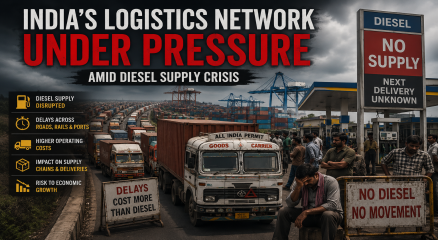
A worsening diesel supply crunch across parts of India has disrupted freight movement, pushed up transportation costs and intensified pressure on the country’s logistics sector, with industry executives warning of broader inflationary spillovers. Transport associations and logistics firms estimate that nearly one in five commercial trucks is currently off the road as operators struggle with fuel shortages and sharply rising diesel prices. The disruption has tightened vehicle availability across major freight corridors, leading to higher trucking rates and delays in cargo movement. The crisis has hit smaller fleet owners particularly hard. These operators, who form the backbone of India’s fragmented trucking industry, are facing mounting operating expenses at a time when profit margins were already under strain from rising maintenance, toll and labour costs. Diesel prices have increased multiple times over the past two weeks following volatility in global crude markets linked to geopolitical tensions in West Asia. Industry bodies said fuel now accounts for nearly half of a truck operator’s total running cost, making it difficult for transporters to absorb additional price increases without passing them on to customers. Freight rates on several high-traffic routes connecting western and northern India have reportedly risen by 10–15%, while local haulage services in some regions have seen even steeper increases. Operators involved in automobile logistics and industrial cargo movement said working capital pressures have also intensified after several fuel stations curtailed credit sales and shifted to advance payment requirements. Large fleet operators acknowledged delays at fuel stations but said operations remain functional for now. Logistics companies have increasingly relied on route optimisation, predictive planning and fuel stock management to limit disruption. Mid-sized operators, however, have already scaled back trips in response to uncertain fuel availability and higher procurement costs. The fuel shortage has been most visible along key transport corridors, where long queues of trucks have formed outside retail fuel stations. Industry executives attributed part of the problem to bulk diesel buyers shifting purchases to retail outlets after institutional fuel prices rose significantly above pump prices, creating supply pressure at public stations. Analysts warned that if elevated diesel prices persist, the impact could extend beyond logistics into consumer markets. Higher freight charges are expected to raise transportation costs for food products, agricultural produce, manufactured goods and other essentials, adding to inflationary pressures already affecting households and businesses. Follow CARGOCONNECT for more such updates.

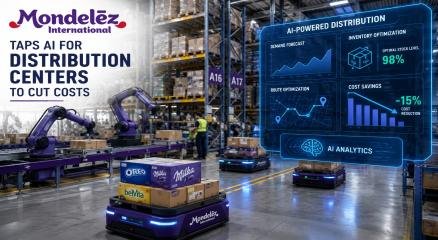
Snack food manufacturer Mondelēz International is increasing the use of automation and artificial intelligence across its U.S. distribution network as part of a broader effort to lower operating costs and improve supply chain efficiency. The company plans to introduce AI-enabled automation at as many as five distribution centers that support its direct-store-delivery network, according to comments made by executives during a recent earnings call. The facilities collectively serve 55 branch locations across the company’s distribution system. Executives said the upgraded fulfillment centers are expected to speed up deliveries to retail outlets, reduce inventory levels and improve overall operational performance. The move forms part of a wider modernization strategy aimed at streamlining manufacturing and logistics operations in the United States. Mondelēz also said it is reshaping portions of its manufacturing footprint. Around 60% of its U.S. production network has already been modernized, while older facilities are being simplified to improve productivity and reduce waste. Company executives indicated that some plants would move away from highly complex production systems in favor of more focused manufacturing lines better suited to individual site capabilities. The company is additionally working to bring more manufacturing and packaging operations in-house. Executives said internalizing production currently handled by co-manufacturers could deliver significant savings. Packaging for mixed cookie and cracker packs, which is a key category for warehouse club retailers is also being shifted internally to reduce inefficiencies and improve flexibility. The supply chain investments are tied to a broader multiyear transformation program launched in 2024. Mondelēz is midway through a $1.2 billion overhaul of its ERP and supply chain systems, a project expected to continue through 2028. The initiative includes upgrades to production capacity, packaging operations and network flexibility across its biscuit, cake and pastry businesses. Follow CARGOCONNECT for more such updates.