
Loading...
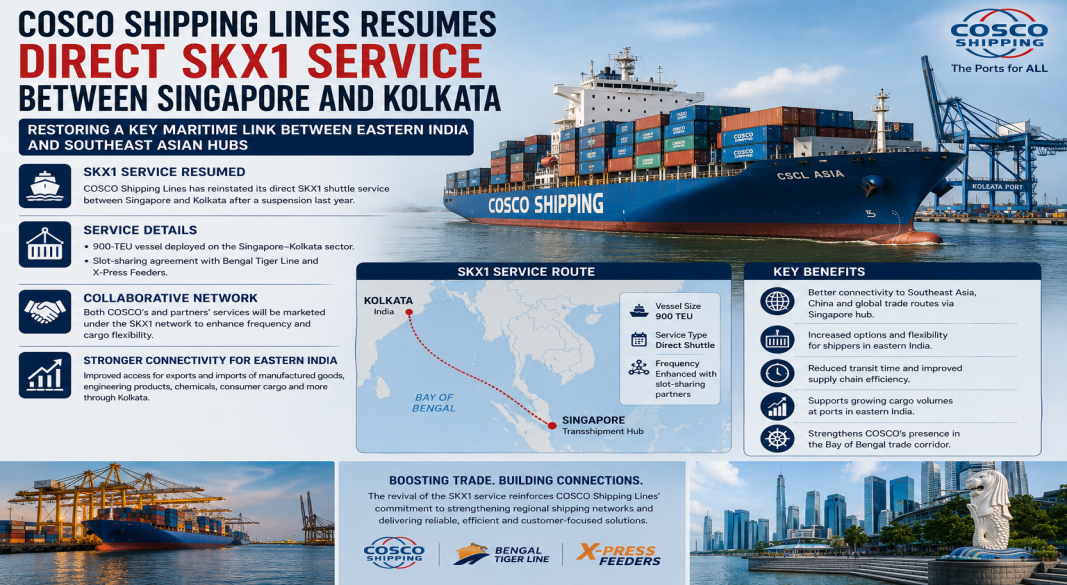
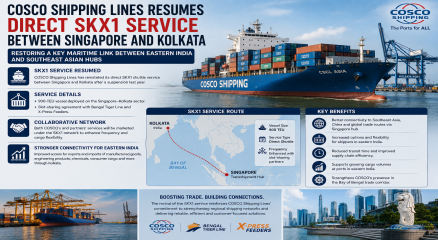
COSCO Shipping Lines has resumed its direct SKX1 shuttle service between Singapore and Kolkata, restoring a key maritime link connecting eastern India with Southeast Asian transshipment hubs after the route was suspended last year.
The revived service will operate with a 900-TEU vessel on the Singapore–Kolkata sector. In addition to deploying its own vessel, COSCO has also entered a slot-sharing arrangement with Bengal Tiger Line and X-Press Feeders on the same trade lane to increase sailing frequency and improve cargo flexibility. Both services will be marketed under the SKX1 network.
The move is expected to improve connectivity for exporters and importers in eastern India, particularly those moving manufactured goods, engineering products, chemicals and consumer cargo through Kolkata. Singapore remains one of the region’s largest transshipment hubs, providing onward connections to Southeast Asia, China and global trade routes.
Industry analysts say the reopening of the corridor reflects growing demand for direct feeder connectivity between Indian ports and major Asian hubs as carriers look to optimise regional networks and reduce transit delays. The service also comes at a time when ports in eastern India are reporting rising cargo volumes and increased container movement.
For COSCO, the reinstatement of the SKX1 service strengthens its presence in the Bay of Bengal trade corridor and expands options for shippers seeking alternatives to longer transshipment routes through competing regional hubs.
Follow CARGOCONNECT for more such updates.
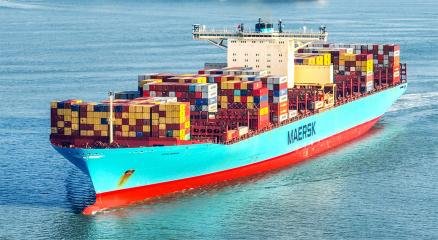
Maersk has launched a new weekly ocean freight service connecting China with India’s western ports, as the global shipping company looks to expand capacity on one of Asia’s busiest trade corridors. The move comes amid growing cargo volumes between the two countries and increasing demand from manufacturers for quicker inland connectivity. The new service, named FI2, will begin its first westbound sailing from Shanghai on June 4 and will operate between key ports in China, Malaysia, India and Pakistan. The route includes Shanghai, Ningbo, Nansha, Tanjung Pelepas, Nhava Sheva, Pipavav and Port Qasim. Maersk said the service will be deployed using six vessels with a carrying capacity of about 4,500 TEUs each. The company introduced the route in response to rising customer demand for additional shipping capacity and more reliable transit schedules between Far East Asia and the Indian subcontinent. A major feature of the new network is its integration with India’s Dedicated Freight Corridor (DFC) through Pipavav port in Gujarat. The rail-linked corridor is expected to improve cargo movement from ports to inland industrial centres across northern India, including Delhi NCR, Gurugram and Noida. The added rail connectivity is likely to benefit sectors dependent on time-sensitive cargo movement, including automotive, chemicals, electronics, retail and industrial manufacturing. Industry executives say direct port-to-rail integration is becoming increasingly important as companies seek to reduce transit delays and improve supply chain visibility. The FI2 route will complement Maersk’s existing FI3 service, giving shippers two direct Far East–India connections. Shipping analysts say additional frequency options could help importers and exporters manage inventory flows more efficiently, particularly at a time when global supply chains continue to face periodic disruptions linked to geopolitical tensions and port congestion. India’s container trade with China has remained strong despite broader geopolitical and economic challenges, driven largely by imports of industrial inputs, machinery, electronics and manufacturing components. Logistics providers have increasingly been investing in integrated multimodal networks to support this growth and improve cargo turnaround times. Follow CARGOCONNECT for more such updates.
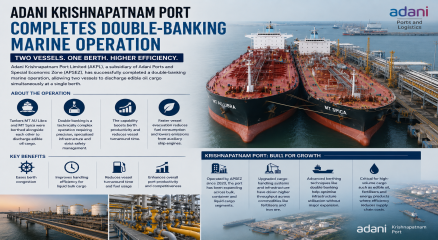
Adani Ports and Special Economic Zone subsidiary Adani Krishnapatnam Port Limited has completed a double-banking marine operation at its Andhra Pradesh facility, allowing two vessels to discharge edible oil cargo simultaneously at a single berth. The move is expected to improve berth productivity and reduce vessel turnaround time at the port. The operation involved tankers MT AU Libra and MT Spica, with one vessel berthed alongside the other during cargo discharge. Double banking is considered a technically demanding procedure in port operations as it requires precise vessel coordination, specialised infrastructure and strict safety management. Only a limited number of Indian ports currently handle such operations on a regular basis. According to the port operator, the capability is aimed at easing berth congestion and increasing handling efficiency for liquid bulk cargo. Faster vessel evacuation can also lower fuel consumption during port stays, helping reduce emissions from auxiliary ship engines. Krishnapatnam Port, operated by APSEZ since its acquisition in 2020, has been expanding its cargo-handling capabilities across bulk, container and liquid cargo segments. The port has recently introduced upgraded cargo-handling systems and has recorded higher throughput across commodities such as fertilisers and iron ore. Industry observers note that advanced berthing techniques such as double banking are becoming increasingly important as ports seek to optimise infrastructure utilisation without large-scale berth expansion projects. The practice is particularly relevant for high-volume cargo categories, including edible oil, fertilisers and energy products, where turnaround efficiency directly impacts supply-chain costs. Follow CARGOCONNECT for more such updates.
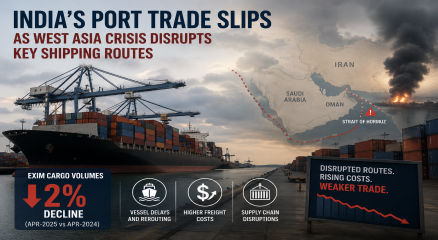
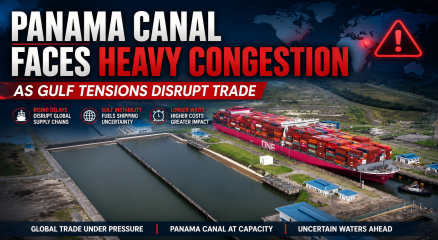
The Panama Canal is operating near full capacity as global shipping patterns shift in response to ongoing disruptions in the Strait of Hormuz, placing fresh pressure on one of the world’s most critical maritime trade routes. Traffic through the canal has risen sharply in recent weeks, driven largely by increased shipments of crude oil, liquefied natural gas (LNG) and refined fuels from the United States to Asian markets. According to shipping association BIMCO, average daily vessel transits through the canal have climbed 8% year-on-year to around 38 ships a day, close to the canal’s operational limit of 36 to 40 transits. The increase follows growing instability around the Strait of Hormuz, a key energy chokepoint that handles a significant share of global oil and gas exports. Reduced shipping activity in the Gulf region and security concerns along Middle East trade routes have forced buyers to seek alternative energy supplies, particularly from the US Gulf Coast. The rerouting of cargoes has significantly increased demand for Panama Canal transit slots, especially among tanker operators. Canal authorities and shipping analysts say waiting times for vessels have increased by nearly 50% compared with last year, with average delays reaching close to two days. Auction prices for last-minute transit slots have also surged as operators compete for limited passage capacity. Container vessels, LPG carriers, oil tankers and dry bulk ships continue to account for the majority of canal traffic. However, energy carriers have emerged as the primary source of growth this year as trade flows adjust to geopolitical disruptions in West Asia. Shipping executives say the congestion reflects a broader restructuring of global supply chains, with cargoes increasingly moving along longer and less conventional routes. Some crude shipments that would normally move through the Gulf are now being redirected through the Atlantic Basin and across Panama toward Asia. The renewed strain on the Panama Canal also raises concerns over future capacity management. The waterway only recently recovered from severe drought conditions that forced transit restrictions during 2023 and 2024. Industry observers warn that another period of low rainfall or El Niño-related weather disruptions could tighten capacity further if elevated shipping demand continues. Analysts say the latest developments underline the growing vulnerability of global trade to disruptions at major maritime chokepoints, where geopolitical tensions in one region can quickly reshape shipping flows and logistics costs worldwide. Follow CARGOCONNECT for more such updates