
Loading...
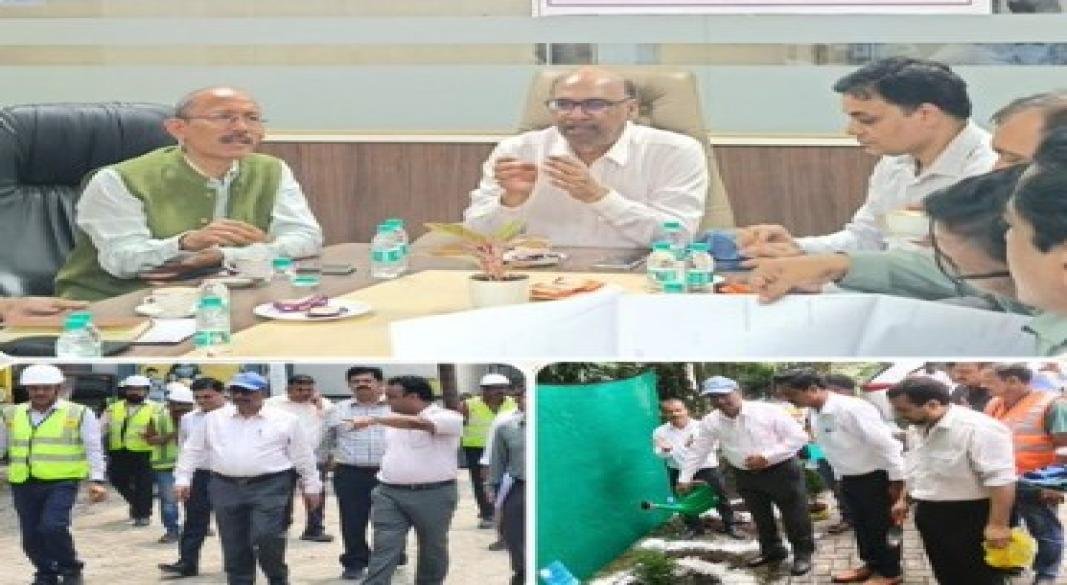
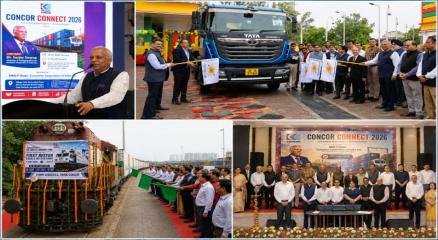
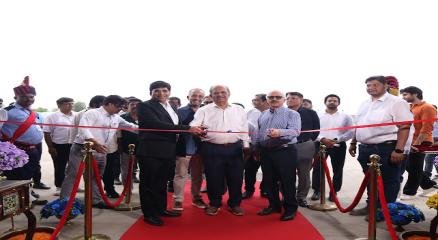
Container Corporation of India (CONCOR) Chairman and Managing Director (CMD) Ajit Kumar Panda visited the Container Freight Station, Dronagiri Rail Terminal (CFS-DRT) in the Mumbai Cluster, as part of the company’s focus on strengthening terminal operations and enhancing rail-linked logistics services.
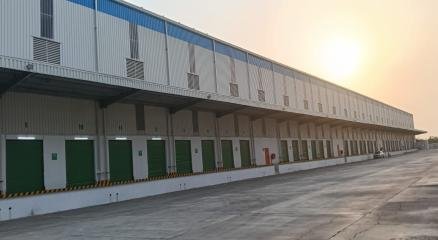
The Dronagiri facility is an important cargo-handling node supporting EXIM and domestic containerised cargo flows in the Mumbai region. CONCOR’s Dronagiri Node, commissioned in March 2003, spans around 59 acres and has an annual handling capacity of approximately 200,000 TEUs. Its catchment extends across Mumbai, Pune, Aurangabad, Vapi, Gujarat and Madhya Pradesh.
During the visit, Panda reviewed the terminal’s operations and interacted with the Mumbai Cluster team, with the engagement highlighting the importance of efficient terminal management, customer-focused services and stronger integration of rail-based freight movement within the wider logistics network.
The Dronagiri facility also supports warehousing and a broad range of EXIM cargo. Its infrastructure includes dedicated EXIM, domestic and bonded warehousing capacity. CONCOR has also developed capabilities at Dronagiri for handling out-of-gauge (ODC) export and import flat-rack containers, supported by first- and last-mile transportation services connecting the CFS with Jawaharlal Nehru Port terminals.
Panda’s visit comes amid CONCOR’s continued emphasis on operational excellence, multimodal connectivity and strengthening logistics infrastructure across key trade gateways. The company has been working to improve rail connectivity, terminal efficiency and customer-centric logistics solutions, supporting more seamless cargo movement across India’s supply chain.
The visit underscores the strategic importance of the Mumbai Cluster and Dronagiri Rail Terminal in facilitating efficient containerised trade and reinforcing CONCOR’s role in India’s rail-based logistics ecosystem.
𝐒𝐭𝐚𝐲 𝐓𝐮𝐧𝐞𝐝 𝐭𝐨 CARGOCONNECT 𝐟𝐨𝐫 𝐥𝐚𝐭𝐞𝐬𝐭 𝐮𝐩𝐝𝐚𝐭𝐞𝐬!
Container Corporation of India (CONCOR) Chairman and Managing Director (CMD) Ajit Kumar Panda visited the Container Freight Station, Dronagiri Rail Terminal (CFS-DRT) in the Mumbai Cluster, as part of the company’s focus on strengthening terminal operations and enhancing rail-linked logistics services. The Dronagiri facility is an important cargo-handling node supporting EXIM and domestic containerised cargo flows in the Mumbai region. CONCOR’s Dronagiri Node, commissioned in March 2003, spans around 59 acres and has an annual handling capacity of approximately 200,000 TEUs. Its catchment extends across Mumbai, Pune, Aurangabad, Vapi, Gujarat and Madhya Pradesh. During the visit, Panda reviewed the terminal’s operations and interacted with the Mumbai Cluster team, with the engagement highlighting the importance of efficient terminal management, customer-focused services and stronger integration of rail-based freight movement within the wider logistics network. The Dronagiri facility also supports warehousing and a broad range of EXIM cargo. Its infrastructure includes dedicated EXIM, domestic and bonded warehousing capacity. CONCOR has also developed capabilities at Dronagiri for handling out-of-gauge (ODC) export and import flat-rack containers, supported by first- and last-mile transportation services connecting the CFS with Jawaharlal Nehru Port terminals. Panda’s visit comes amid CONCOR’s continued emphasis on operational excellence, multimodal connectivity and strengthening logistics infrastructure across key trade gateways. The company has been working to improve rail connectivity, terminal efficiency and customer-centric logistics solutions, supporting more seamless cargo movement across India’s supply chain. The visit underscores the strategic importance of the Mumbai Cluster and Dronagiri Rail Terminal in facilitating efficient containerised trade and reinforcing CONCOR’s role in India’s rail-based logistics ecosystem. 𝐒𝐭𝐚𝐲 𝐓𝐮𝐧𝐞𝐝 𝐭𝐨 CARGOCONNECT 𝐟𝐨𝐫 𝐥𝐚𝐭𝐞𝐬𝐭 𝐮𝐩𝐝𝐚𝐭𝐞𝐬!

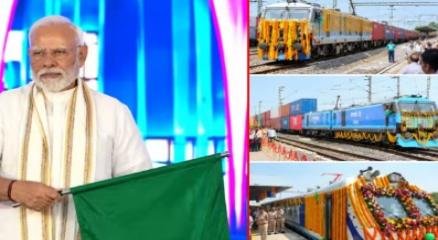
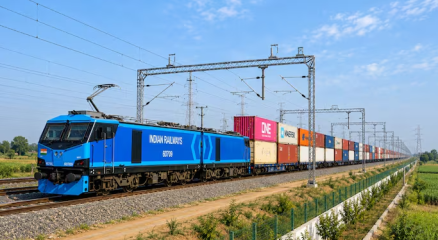
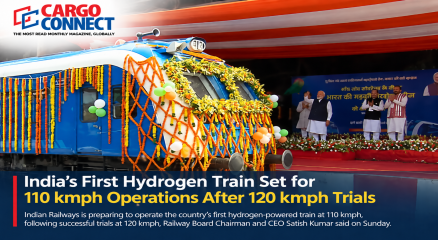
Indore: Indian Railways is preparing to operate the country’s first hydrogen-powered train at speeds of up to 110 kmph, following successful trials at speeds of 120 kmph, Railway Board Chairman and CEO Satish Kumar said on Sunday. Prime Minister Narendra Modi had flagged off India’s first hydrogen-powered train on July 17, marking a significant step in the Railways’ efforts to introduce cleaner propulsion technologies. The train operates on the 89-km Jind–Sonipat route in Haryana. Unlike conventional electric trains that rely on overhead power lines, the hydrogen fuel-cell trainset generates electricity onboard through an electrochemical reaction between hydrogen and oxygen. The process produces water vapour and heat as by-products, eliminating combustion, smoke and tailpipe carbon emissions. The hydrogen train is part of Indian Railways’ broader efforts to explore alternative propulsion technologies and reduce emissions from rail operations. Its deployment could also offer a pathway for cleaner rail connectivity on routes where conventional electrification may be less practical. Follow CARGOCONNECT for more such updates
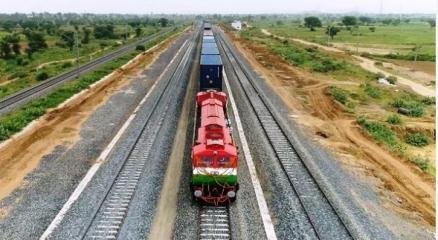
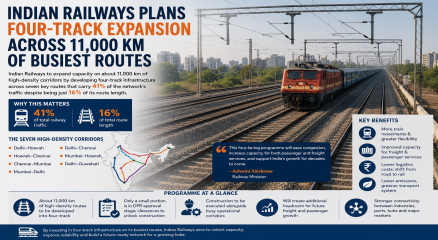
Indian Railways plans to expand capacity on about 11,000 km of high-density routes by developing four-track infrastructure, targeting corridors that currently carry roughly 41% of the railway network’s traffic despite accounting for only 16% of its route length. Railway Minister Ashwini Vaishnaw said the programme covers seven major corridors linking some of India’s largest industrial, commercial and population centres. The proposed expansion is intended to ease congestion and provide additional capacity for both freight and passenger services as demand increases. The seven identified routes are Delhi–Howrah, Howrah–Chennai, Chennai–Mumbai, Mumbai–Delhi, Delhi–Chennai, Mumbai–Howrah and Delhi–Guwahati. Together, they form the core of the railway network’s high-density traffic corridors. The four-laning programme would create four railway lines along the identified routes, allowing the network to accommodate more train movements and providing greater flexibility in managing passenger and freight traffic. Some sections already have four tracks, while work is under way on other stretches. According to Vaishnaw, only a relatively small portion of the identified network remains in the detailed project report approval stage, with construction expected to proceed as project clearances are completed. For freight operators, additional capacity on these trunk routes could improve the availability and reliability of train paths, particularly on sections where passenger and goods services compete for limited track capacity. It could also support the wider shift of cargo from road to rail by providing more room for freight services. The expansion would complement the Eastern and Western Dedicated Freight Corridors, which have added dedicated infrastructure for freight movement on two major national routes. Additional capacity on the conventional network could help improve connectivity between production centres, ports, distribution hubs and major consumption markets. The government has also linked greater rail capacity to its objective of reducing logistics costs. Vaishnaw has cited lower per-tonne-kilometre transport costs for rail compared with road as a reason for expanding the network, while also pointing to rail’s lower environmental impact. By concentrating investment on corridors responsible for a disproportionate share of traffic, Indian Railways is seeking to address its most significant capacity constraints while creating additional headroom for future growth in freight and passenger movement. Follow CARGOCONNECT for more such updates