
Loading...
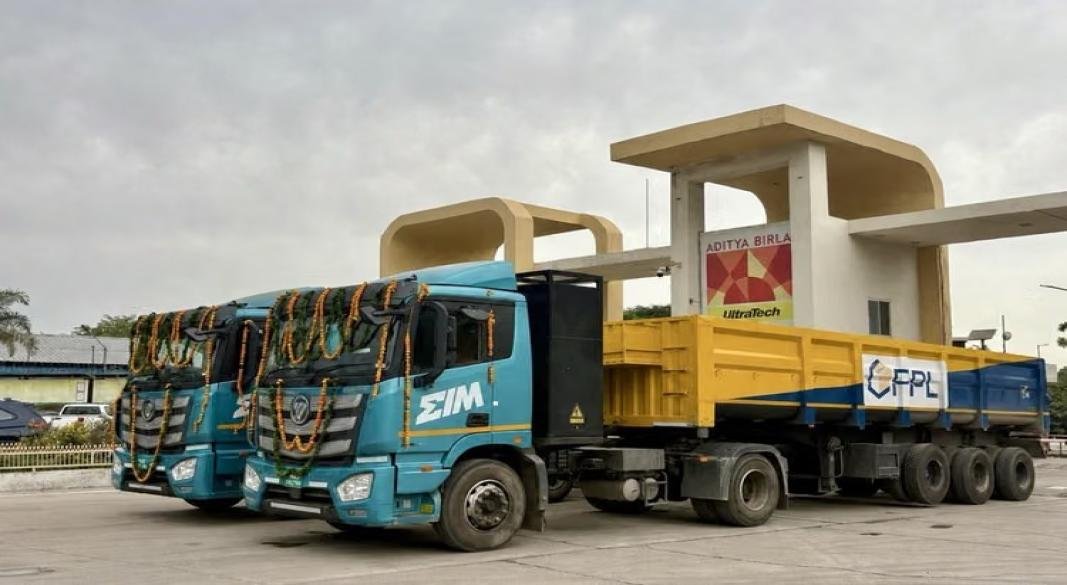
UltraTech Cement has deployed 45 electric heavy-duty trucks for clinker transportation in northern India, marking one of the largest electric trucking deployments in the region’s cement sector and expanding the company’s efforts to decarbonise logistics operations.
The new fleet will transport clinker from UltraTech’s Kotputli Cement Works in Rajasthan to its grinding units at Dadri and Sikandarabad in the Delhi-NCR region. The route spans approximately 250 kilometres and passes through Rajasthan, Haryana and Uttar Pradesh. The deployment is being undertaken in partnership with Energy In Motion and follows the signing of a transport service agreement involving the company and its logistics partners.
Each vehicle in the fleet has a carrying capacity of 55 tonnes, enabling the movement of large volumes of clinker on a key supply corridor for UltraTech’s northern operations. The company estimates that the electric trucks will reduce carbon dioxide emissions by more than 8,900 tonnes annually while replacing the consumption of approximately 2.9 million litres of diesel each year.
The initiative represents a significant step in the commercialisation of long-haul electric freight transportation in India’s heavy manufacturing sector. By deploying battery-powered trucks on a high-volume industrial route, UltraTech aims to demonstrate the operational viability of electric heavy-duty vehicles for large-scale cargo movement across multiple states.
Commenting on the development, K.C. Jhanwar, Managing Director of UltraTech Cement, said the company views logistics decarbonisation as an important component of its broader sustainability strategy and its efforts to reduce dependence on fossil fuels across the supply chain.
The latest deployment adds to UltraTech’s growing portfolio of low-emission transport assets. The company was among the early adopters of cleaner freight solutions in the cement industry, introducing compressed natural gas (CNG) trucks in 2021, liquefied natural gas (LNG) trucks in 2022 and electric trucks in 2024. As of FY26, UltraTech operates 638 CNG trucks, 32 LNG trucks and 89 electric trucks across its manufacturing network. The addition of 45 new electric vehicles further expands its fleet of more than 750 green trucks.
The deployment follows a series of electric mobility initiatives undertaken by the company over the past two years. UltraTech began testing electric trucks for clinker movement in 2024 and subsequently scaled up operations on other routes after pilot projects demonstrated operational feasibility.
As India seeks to reduce emissions from freight transportation and accelerate the adoption of electric commercial vehicles, large-scale deployments such as UltraTech’s are increasingly being viewed as important test cases for the future of long-distance industrial logistics. The company said it will continue working with logistics partners and technology providers to expand the use of cleaner transportation solutions across its supply chain.
Follow CARGOCONNECT for more such updates.

UltraTech Cement has deployed 45 electric heavy-duty trucks for clinker transportation in northern India, marking one of the largest electric trucking deployments in the region’s cement sector and expanding the company’s efforts to decarbonise logistics operations. The new fleet will transport clinker from UltraTech’s Kotputli Cement Works in Rajasthan to its grinding units at Dadri and Sikandarabad in the Delhi-NCR region. The route spans approximately 250 kilometres and passes through Rajasthan, Haryana and Uttar Pradesh. The deployment is being undertaken in partnership with Energy In Motion and follows the signing of a transport service agreement involving the company and its logistics partners. Each vehicle in the fleet has a carrying capacity of 55 tonnes, enabling the movement of large volumes of clinker on a key supply corridor for UltraTech’s northern operations. The company estimates that the electric trucks will reduce carbon dioxide emissions by more than 8,900 tonnes annually while replacing the consumption of approximately 2.9 million litres of diesel each year. The initiative represents a significant step in the commercialisation of long-haul electric freight transportation in India’s heavy manufacturing sector. By deploying battery-powered trucks on a high-volume industrial route, UltraTech aims to demonstrate the operational viability of electric heavy-duty vehicles for large-scale cargo movement across multiple states. Commenting on the development, K.C. Jhanwar, Managing Director of UltraTech Cement, said the company views logistics decarbonisation as an important component of its broader sustainability strategy and its efforts to reduce dependence on fossil fuels across the supply chain. The latest deployment adds to UltraTech’s growing portfolio of low-emission transport assets. The company was among the early adopters of cleaner freight solutions in the cement industry, introducing compressed natural gas (CNG) trucks in 2021, liquefied natural gas (LNG) trucks in 2022 and electric trucks in 2024. As of FY26, UltraTech operates 638 CNG trucks, 32 LNG trucks and 89 electric trucks across its manufacturing network. The addition of 45 new electric vehicles further expands its fleet of more than 750 green trucks. The deployment follows a series of electric mobility initiatives undertaken by the company over the past two years. UltraTech began testing electric trucks for clinker movement in 2024 and subsequently scaled up operations on other routes after pilot projects demonstrated operational feasibility. As India seeks to reduce emissions from freight transportation and accelerate the adoption of electric commercial vehicles, large-scale deployments such as UltraTech’s are increasingly being viewed as important test cases for the future of long-distance industrial logistics. The company said it will continue working with logistics partners and technology providers to expand the use of cleaner transportation solutions across its supply chain. Follow CARGOCONNECT for more such updates.

CEVA Logistics has expanded its presence in West Africa through a new joint venture with EFL Africa, a leading Nigerian logistics company. The newly established entity, CEVA EFL Limited, is expected to enhance logistics connectivity across Nigeria and provide customers with greater access to international supply chain networks. The partnership brings together CEVA Logistics’ extensive global reach and end-to-end logistics capabilities with EFL Africa’s established local infrastructure and market expertise. The move underscores the growing importance of Nigeria as a strategic logistics hub and gateway to West Africa, a region experiencing increasing trade activity and supply chain investments. Through the joint venture, businesses operating in Nigeria will gain access to a broader portfolio of integrated logistics services, including freight forwarding, transportation, customs brokerage, warehousing and inland logistics solutions. By combining local market knowledge with international logistics capabilities, CEVA EFL aims to address longstanding operational challenges while improving supply chain efficiency for customers across the region. A key feature of the new operation is its dedicated barge transportation service designed to move containers between Lagos ports and Inland Container Depots (ICDs). The initiative is expected to reduce reliance on congested road networks, shorten transit times and improve cargo flow in one of Africa’s busiest logistics corridors. The venture will also leverage approximately 140,000 square metres of ICD infrastructure located in Ikorodu and Apapa, including an Export Processing Terminal that supports import and export activities. In addition, CEVA EFL will provide customs clearance services through an in-house licensed team, enabling faster cargo processing and greater visibility throughout the supply chain. Industry observers view the development as a significant step toward modernising logistics operations in Nigeria while strengthening the country’s role in regional trade. The joint venture is also expected to support knowledge transfer and workforce development by combining global best practices with local operational expertise. Executives from both organisations have highlighted the partnership’s potential to create more resilient and customer-focused logistics solutions while contributing to economic growth in Nigeria and the wider West African market. As supply chains continue to evolve across Africa, the launch of CEVA EFL reflects a broader trend of international logistics providers investing in strategic regional partnerships to strengthen market access, improve infrastructure utilisation and support cross-border trade growth. 𝐒𝐭𝐚𝐲 𝐓𝐮𝐧𝐞𝐝 𝐭𝐨 CARGOCONNECT 𝐟𝐨𝐫 𝐥𝐚𝐭𝐞𝐬𝐭 𝐮𝐩𝐝𝐚𝐭𝐞𝐬!


The Centre has decided to proceed with a new ₹13,000-crore greenfield civil-military airport in Great Nicobar Island, abandoning long-standing plans to expand the Indian Navy’s INS Baaz air station. The move marks a significant shift in India’s infrastructure strategy for the strategically located island in the eastern Indian Ocean. According to government and defence sources, the proposed dual-use airport will be developed at Chingen near Galathea Bay and will cater to both civilian and military operations. The facility forms a key component of the broader Great Nicobar Island Development Project, which carries an estimated investment of around ₹81,000 crore and includes a transshipment port, power infrastructure and township development. The decision effectively ends proposals to extend the runway at INS Baaz in Campbell Bay. Studies conducted over the past several years reportedly found that expanding the existing naval airfield would be technically challenging due to terrain constraints, navigational limitations and the requirement for substantial supporting infrastructure. Located close to the Malacca Strait, one of the world’s busiest maritime trade routes, the new airport is expected to strengthen India’s logistics capabilities, improve connectivity to the remote island territory and support military operations in the Indo-Pacific region. Defence officials have indicated that the airport will remain under naval operational control while also serving civilian aviation requirements. Construction is expected to be completed within five years. The airport project is part of the government’s broader effort to develop Great Nicobar as a strategic and economic hub. Authorities argue that the new facility will enhance surveillance, maritime domain awareness, disaster-response capabilities and logistical reach across the Andaman and Nicobar archipelago. However, the wider Great Nicobar development programme continues to face scrutiny from environmental groups and opposition leaders, who have raised concerns about its potential impact on rainforests, coral ecosystems and indigenous communities. Critics have questioned whether the economic and strategic benefits outweigh the environmental costs associated with large-scale infrastructure development on the ecologically sensitive island. Despite the debate, the government maintains that the project is essential for strengthening India’s strategic presence in the Indian Ocean region while improving connectivity and economic opportunities in one of the country’s most remote territories. Follow CARGOCONNECT for more such updates