
Loading...
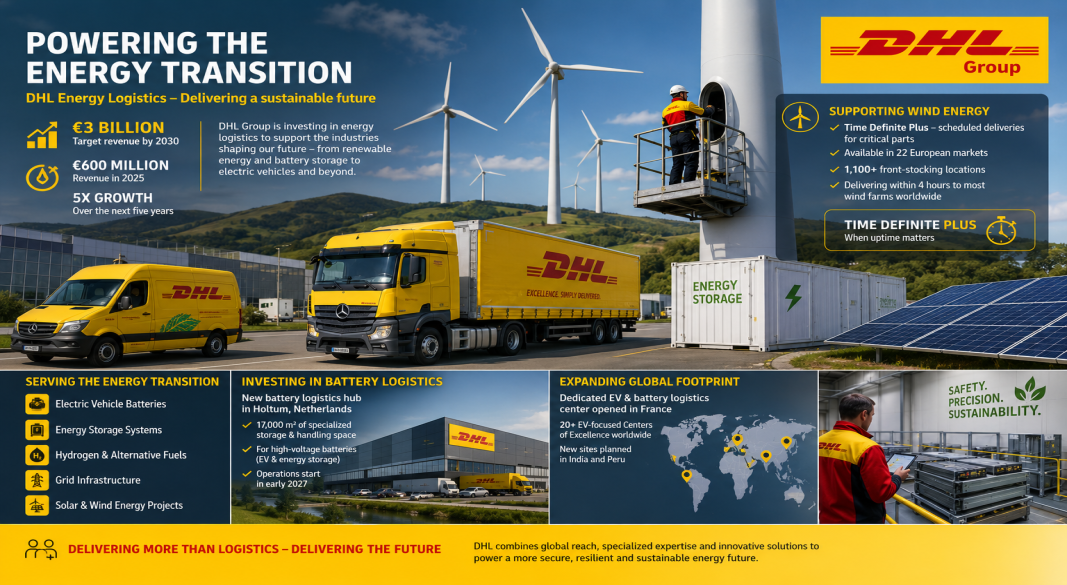
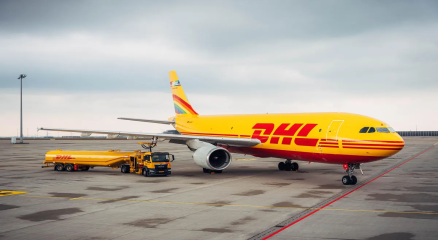
DHL Group plans to increase revenue from its energy logistics operations to €3 billion by 2030, betting on growing demand for supply chain services that support renewable energy, battery storage, electric vehicles, and other emerging energy sectors.
The German logistics company said revenue from its new energy logistics activities reached approximately €600 million in 2025 and is expected to grow fivefold over the next five years. The target forms part of DHL’s broader growth strategy, which identifies energy-related supply chains as a key long-term opportunity.
The company is expanding services across its express, freight forwarding and contract logistics businesses to support industries involved in the energy transition. DHL said increasing concerns over energy security and supply chain resilience are driving customer demand for specialized logistics solutions.
To strengthen its position in the sector, DHL has developed logistics offerings covering multiple segments, including electric vehicle batteries, energy storage systems, hydrogen, alternative fuels, grid infrastructure, and solar and wind energy projects.
A major focus is the wind energy industry, where DHL sees growing demand for maintenance and spare-parts logistics as installed capacity continues to expand worldwide. The company has introduced a new service, Time Definite Plus, initially available in 22 European markets, that provides scheduled deliveries and customized transport options for critical components and replacement parts.
DHL said its network of more than 1,100 front-stocking locations enables it to deliver spare parts to most wind farms globally within four hours, helping operators reduce equipment downtime.
The company is also increasing investment in battery logistics infrastructure. Construction is underway on a new battery logistics hub in Holtum, the Netherlands, which is expected to begin operations in early 2027. The facility will provide 17,000 square metres of specialized storage and handling space for high-voltage batteries used in electric vehicles and energy storage systems.
In France, DHL has opened a dedicated electric vehicle and battery logistics center and plans to expand similar facilities in other markets. The company currently operates more than 20 EV-focused Centers of Excellence worldwide, with additional sites planned in India and Peru.
The expansion reflects DHL’s effort to capture a larger share of supply chains linked to the global shift toward diversified energy sources while positioning itself as a logistics provider for both energy infrastructure development and aftermarket support services.
Follow CARGOCONNECT for more such updates.
DHL Group plans to increase revenue from its energy logistics operations to €3 billion by 2030, betting on growing demand for supply chain services that support renewable energy, battery storage, electric vehicles, and other emerging energy sectors. The German logistics company said revenue from its new energy logistics activities reached approximately €600 million in 2025 and is expected to grow fivefold over the next five years. The target forms part of DHL’s broader growth strategy, which identifies energy-related supply chains as a key long-term opportunity. The company is expanding services across its express, freight forwarding and contract logistics businesses to support industries involved in the energy transition. DHL said increasing concerns over energy security and supply chain resilience are driving customer demand for specialized logistics solutions. To strengthen its position in the sector, DHL has developed logistics offerings covering multiple segments, including electric vehicle batteries, energy storage systems, hydrogen, alternative fuels, grid infrastructure, and solar and wind energy projects. A major focus is the wind energy industry, where DHL sees growing demand for maintenance and spare-parts logistics as installed capacity continues to expand worldwide. The company has introduced a new service, Time Definite Plus, initially available in 22 European markets, that provides scheduled deliveries and customized transport options for critical components and replacement parts. DHL said its network of more than 1,100 front-stocking locations enables it to deliver spare parts to most wind farms globally within four hours, helping operators reduce equipment downtime. The company is also increasing investment in battery logistics infrastructure. Construction is underway on a new battery logistics hub in Holtum, the Netherlands, which is expected to begin operations in early 2027. The facility will provide 17,000 square metres of specialized storage and handling space for high-voltage batteries used in electric vehicles and energy storage systems. In France, DHL has opened a dedicated electric vehicle and battery logistics center and plans to expand similar facilities in other markets. The company currently operates more than 20 EV-focused Centers of Excellence worldwide, with additional sites planned in India and Peru. The expansion reflects DHL’s effort to capture a larger share of supply chains linked to the global shift toward diversified energy sources while positioning itself as a logistics provider for both energy infrastructure development and aftermarket support services. Follow CARGOCONNECT for more such updates.
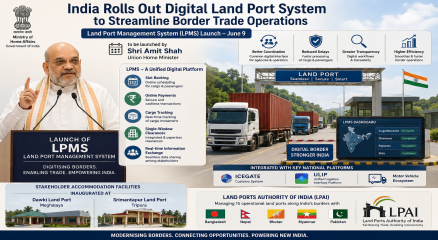
India is set to take a major step towards digitising cross-border trade and passenger movement with the launch of the Land Port Management System (LPMS) on June 9. Union Home Minister Amit Shah will formally unveil the platform in New Delhi, marking a significant upgrade in the management of the country's land border infrastructure. The LPMS has been developed as a unified digital platform to connect operations across India's land ports. The system is designed to enable end-to-end digital processing for both cargo and passenger movement, replacing manual procedures with integrated online workflows. According to the Ministry of Home Affairs, the platform will support functions such as slot booking, online payments, cargo tracking and single-window clearances. It will also facilitate real-time exchange of logistics and regulatory information among stakeholders involved in border trade and transport operations. The new system is expected to improve coordination between government agencies and private operators by providing a common digital interface. Authorities say the initiative aims to reduce processing delays, enhance transparency and improve the efficiency of cargo movement across land borders. LPMS has been integrated with key national logistics and customs platforms, including ICEGATE, the Unified Logistics Interface Platform (ULIP) and the motor vehicle ecosystem, allowing smoother data sharing and regulatory compliance. The launch comes as India continues efforts to modernise border infrastructure and strengthen trade facilitation through technology-led solutions. By introducing digital workflows at land ports, the government aims to bring border operations closer to the standards already established at major airports and seaports. Alongside the launch of LPMS, Shah will also inaugurate newly developed stakeholder accommodation facilities at the Dawki Land Port in Meghalaya and the Srimantapur Land Port in Tripura. The facilities are intended to support border personnel and other stakeholders operating at these locations. The Land Ports Authority of India (LPAI), which functions under the Ministry of Home Affairs, currently manages 15 operational land ports along India's borders with Bangladesh, Nepal, Bhutan, Myanmar and Pakistan. The authority is responsible for developing and maintaining infrastructure that supports trade, travel and border management at these crossings. Follow CARGOCONNECT for more such updates.
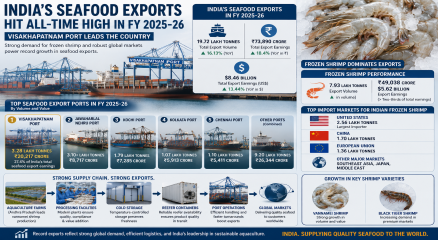
India’s seafood exports reached an all-time high in fiscal year 2025-26, supported by strong international demand and rising shipments of frozen shrimp, with Visakhapatnam Port emerging as the country’s leading export gateway for marine products. According to the Marine Products Export Development Authority (MPEDA), India exported 19.72 lakh tonnes of seafood during the fiscal year, generating ₹73,890 crore ($8.46 billion). Export volumes increased by 16.13 per cent year-on-year, while export earnings rose 18.4 per cent in rupee terms and 13.44 per cent in dollar value. Visakhapatnam Port handled the largest share of the country’s seafood exports, processing 3.28 lakh tonnes of cargo valued at ₹20,217 crore. The port accounted for approximately 27.4 per cent of India’s total seafood export earnings, highlighting its growing role in the country's cold-chain and export logistics network. The port’s performance has been supported by Andhra Pradesh’s extensive aquaculture industry, particularly the production of vannamei shrimp, one of India’s most important seafood export products. The proximity of processing facilities, aquaculture farms and export infrastructure has strengthened Visakhapatnam’s position as a key gateway for marine exports. Jawaharlal Nehru Port ranked second, handling more than 3.1 lakh tonnes of seafood exports worth ₹8,717 crore. Kochi Port secured third place with over 1.79 lakh tonnes valued at ₹7,285 crore, followed by Kolkata Port with 1.07 lakh tonnes worth ₹5,913 crore. Chennai Port handled 1.10 lakh tonnes of seafood exports valued at ₹5,411 crore, while other ports collectively processed 9.2 lakh tonnes worth ₹26,344 crore. Frozen shrimp remained the dominant export commodity, contributing ₹49,038 crore ($5.62 billion) and accounting for more than two-thirds of India’s seafood export earnings. The country exported 7.93 lakh tonnes of frozen shrimp during the fiscal year, with the segment recording growth in both volume and value. The United States retained its position as the largest importer of Indian frozen shrimp, purchasing 2.56 lakh tonnes. China followed with imports of 1.70 lakh tonnes, while the European Union imported 1.36 lakh tonnes. Other major markets included Southeast Asia, Japan and the Middle East. From a supply chain perspective, the record export performance underscores the increasing importance of integrated cold-chain infrastructure, reefer container availability and efficient port operations in supporting India's seafood trade. As demand from major global markets continues to grow, logistics efficiency will remain a critical factor in maintaining the competitiveness of Indian marine exports. Industry officials also reported growth in exports of vannamei and Black Tiger shrimp, reinforcing the importance of aquaculture-driven supply chains in sustaining the sector’s expansion and export earnings. Follow CARGOCONNECT for more such updates.