
Loading...

The International Air Transport Association (IATA) has appointed Saadia Zahidi as its next Director General, making history as the first woman to lead the global airline body in its more than 80-year history. Effective 1 November 2026, Zahidi will become IATA’s ninth Director General, succeeding Willie Walsh, whose tenure concludes on 31 July. Until Zahidi assumes office, Sandrine Le Borgne, IATA’s Chief Financial Officer and Senior Vice President for Corporate Services, will serve as Interim Director General.
The appointment comes at a pivotal time for the aviation and air cargo industries, which are navigating a rapidly evolving landscape shaped by geopolitical uncertainties, digital transformation, sustainability commitments and shifting global trade patterns. Representing more than 370 airlines across over 120 countries, IATA accounts for approximately 85% of global air traffic, making its leadership decisions highly significant for the wider aviation, logistics and supply chain ecosystem.
Zahidi joins IATA from the World Economic Forum (WEF), where she served as Managing Director and Member of the Managing Board for more than two decades. During her tenure, she led the Forum’s Centre for the New Economy and Society and spearheaded initiatives focused on the future of work, economic growth, technological transformation and workforce development. Her background in economics and public policy is expected to bring a broader strategic perspective to an industry facing unprecedented technological and regulatory changes.
Welcoming the appointment, IATA Board Chair Roberto Alvo said Zahidi’s extensive international experience would strengthen the association’s role as the voice of the global airline industry. He noted that aviation is entering a period where technology, sustainability and geopolitical developments will fundamentally reshape global connectivity, requiring collaborative leadership and long-term vision.
For the supply chain and logistics sector, Zahidi’s appointment carries particular significance. Air freight remains a critical enabler of global commerce, supporting high-value manufacturing, pharmaceutical distribution, e-commerce and time-sensitive cargo movements. As airlines continue to invest in digital cargo solutions, operational resilience and decarbonisation, IATA’s leadership will play a crucial role in driving industry standards, regulatory advocacy and cross-border collaboration.
In her first statement following the appointment, Zahidi described aviation as essential infrastructure that underpins economic growth, trade, tourism, employment and investment. She emphasised that IATA’s mission of representing, leading and serving the airline industry is more important than ever as global challenges demand stronger cooperation across governments, airlines and supply chain stakeholders.
Beyond breaking a long-standing gender barrier, Zahidi’s appointment signals a strategic leadership transition for IATA as the aviation industry prepares for its next phase of growth. With sustainability targets, digital innovation and supply chain resilience topping the industry agenda, her tenure is expected to shape how global aviation responds to future economic and operational challenges while strengthening its role in facilitating international trade and logistics.
𝐒𝐭𝐚𝐲 𝐓𝐮𝐧𝐞𝐝 𝐭𝐨 CARGOCONNECT 𝐟𝐨𝐫 𝐥𝐚𝐭𝐞𝐬𝐭 𝐮𝐩𝐝𝐚𝐭𝐞𝐬

The International Air Transport Association (IATA) has appointed Saadia Zahidi as its next Director General, making history as the first woman to lead the global airline body in its more than 80-year history. Effective 1 November 2026, Zahidi will become IATA’s ninth Director General, succeeding Willie Walsh, whose tenure concludes on 31 July. Until Zahidi assumes office, Sandrine Le Borgne, IATA’s Chief Financial Officer and Senior Vice President for Corporate Services, will serve as Interim Director General. The appointment comes at a pivotal time for the aviation and air cargo industries, which are navigating a rapidly evolving landscape shaped by geopolitical uncertainties, digital transformation, sustainability commitments and shifting global trade patterns. Representing more than 370 airlines across over 120 countries, IATA accounts for approximately 85% of global air traffic, making its leadership decisions highly significant for the wider aviation, logistics and supply chain ecosystem. Zahidi joins IATA from the World Economic Forum (WEF), where she served as Managing Director and Member of the Managing Board for more than two decades. During her tenure, she led the Forum’s Centre for the New Economy and Society and spearheaded initiatives focused on the future of work, economic growth, technological transformation and workforce development. Her background in economics and public policy is expected to bring a broader strategic perspective to an industry facing unprecedented technological and regulatory changes. Welcoming the appointment, IATA Board Chair Roberto Alvo said Zahidi’s extensive international experience would strengthen the association’s role as the voice of the global airline industry. He noted that aviation is entering a period where technology, sustainability and geopolitical developments will fundamentally reshape global connectivity, requiring collaborative leadership and long-term vision. For the supply chain and logistics sector, Zahidi’s appointment carries particular significance. Air freight remains a critical enabler of global commerce, supporting high-value manufacturing, pharmaceutical distribution, e-commerce and time-sensitive cargo movements. As airlines continue to invest in digital cargo solutions, operational resilience and decarbonisation, IATA’s leadership will play a crucial role in driving industry standards, regulatory advocacy and cross-border collaboration. In her first statement following the appointment, Zahidi described aviation as essential infrastructure that underpins economic growth, trade, tourism, employment and investment. She emphasised that IATA’s mission of representing, leading and serving the airline industry is more important than ever as global challenges demand stronger cooperation across governments, airlines and supply chain stakeholders. Beyond breaking a long-standing gender barrier, Zahidi’s appointment signals a strategic leadership transition for IATA as the aviation industry prepares for its next phase of growth. With sustainability targets, digital innovation and supply chain resilience topping the industry agenda, her tenure is expected to shape how global aviation responds to future economic and operational challenges while strengthening its role in facilitating international trade and logistics. 𝐒𝐭𝐚𝐲 𝐓𝐮𝐧𝐞𝐝 𝐭𝐨 CARGOCONNECT 𝐟𝐨𝐫 𝐥𝐚𝐭𝐞𝐬𝐭 𝐮𝐩𝐝𝐚𝐭𝐞𝐬



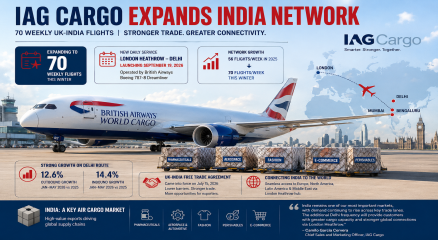
IAG Cargo is significantly strengthening its India operations by increasing its UK-India network to 70 weekly flights, underscoring the country's growing importance in global air cargo. The expansion includes the launch of a third daily London Heathrow–Delhi service from September 19, 2026, creating additional capacity for exporters shipping high-value and time-sensitive cargo. The new year-round service will be operated by British Airways using a Boeing 787-8 Dreamliner. With the addition, IAG Cargo will operate three daily services each to Delhi and Mumbai, alongside increased frequencies to Bengaluru, taking its total India schedule from 56 weekly flights in 2025 to 70 this winter. The capacity expansion comes at a strategic moment, just days after the UK-India Free Trade Agreement (FTA) came into force on July 15. The agreement is expected to accelerate bilateral trade by lowering barriers and boosting exports across multiple sectors, creating fresh opportunities for air cargo operators serving one of the world's fastest-growing trade corridors. According to IAG Cargo, demand on the Delhi route has been particularly robust. Between January and May 2026, outbound cargo volumes from Delhi increased 12.6%, while inbound volumes grew 14.4% compared with the same period last year. The airline expects the additional frequencies to support rising shipment volumes while offering businesses improved connectivity to Europe, North America, Latin America and the Middle East through its London Heathrow hub. India continues to be a major export market for high-value air freight, including pharmaceuticals, aerospace and automotive components, fashion, perishables and rapidly growing e-commerce shipments. Industry data also indicates that India's export air cargo volumes increased by around 5% during the first five months of 2026, reinforcing the country's expanding role in international supply chains. Commenting on the expansion, Camilo Garcia Cervera, Chief Sales and Marketing Officer at IAG Cargo, said India remains one of the airline's most important markets, with demand continuing to rise across key trade lanes. He noted that the additional Delhi frequency will provide customers with greater cargo capacity and stronger global connections via London Heathrow. The latest expansion reflects a broader trend among international carriers increasing investments in India as manufacturing, pharmaceuticals, electronics and e-commerce exports continue to drive demand for reliable long-haul air freight capacity. With stronger trade ties between India and the UK and improving global connectivity, airlines are positioning themselves to capture the next phase of growth in one of the world's fastest-expanding cargo markets. Follow CARGOCONNECT for more such updates.

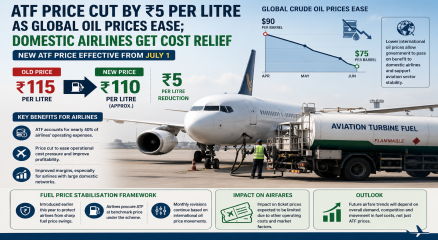
Domestic airlines will pay less for aviation turbine fuel (ATF) from July 1 after the government reduced jet fuel prices by nearly ₹5 per litre, bringing the rate to around ₹110 per litre. The revision follows a decline in international crude oil prices and is expected to provide operational cost relief to airlines after a period of elevated fuel prices. ATF is one of the largest cost components for airlines, accounting for nearly 40% of their operating expenses. The latest reduction is expected to ease financial pressure on carriers, although industry observers say the impact on passenger airfares is likely to be limited as airlines continue to manage other operating costs. The monthly revision comes after the government introduced a fuel price stabilisation framework earlier this year to shield domestic airlines from sharp swings in global jet fuel prices. Under the mechanism, participating carriers procure ATF at a benchmark price, while periodic adjustments continue to reflect movements in international oil markets. The reduction follows a moderation in global crude oil prices after recent volatility linked to geopolitical tensions. Lower international fuel prices have allowed authorities to pass on part of the benefit to domestic airlines while maintaining the broader objective of ensuring fare stability and uninterrupted air connectivity. Industry experts believe the latest price cut will improve airline margins, particularly for carriers operating large domestic networks. However, any significant reduction in ticket prices will depend on overall market demand, competition and future movements in fuel costs rather than ATF prices alone. Follow CARGOCONNECT for more such updates.