
Loading...
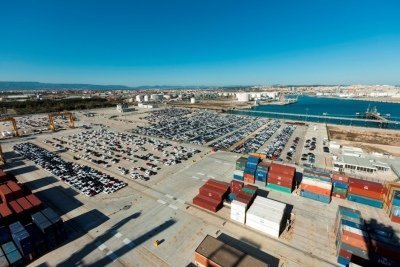
The International Port Community Systems Association (IPCSA), which is celebrating its tenth anniversary this year, has welcomed another new member – Puertos del Estado, the public body responsible for state-owned Spanish ports.
Spain’s ports handle more than half of its trade within the EU and 96% of its trade with third countries. A total of 46 ports are managed by 28 port authorities, which report directly to Puertos del Estado.
“Some of our ports are already individual members of IPCSA because they have their own Port Community Systems,” says Mar Chao López, Director of Operations at Puertos del Estado. “It is really valuable for Puertos del Estado to be a member of IPCSA because we provide the Maritime Single Window for all Spanish ports and are also working on the implementation of the European Single Window."
“However, the most important reason for being a member of IPCSA is that we are also developing a major project, SIMPLE – a Single Window which will cover all modes of transport in Spain.”
Supported by the Connecting Europe Facility (CEF), the SIMPLE Technological Platform (SIMplification of Processes for a Logistic Enhancement) represents another major step in the digitalisation and sustainability process launched by Spain’s port system.
“Puertos del Estado works to coordinate and facilitate the whole maritime and ports policy,” says Mar Chao López. “While some of our larger ports are already connected to IPCSA, our membership is particularly important as we are the provider of Single Window and PCS support for smaller Spanish ports. These smaller ports often don’t have the resources or a voice – we are the ones that provide them with a digital platform and support, and we must be as updated as possible.”
"As well as keeping up to date with other members’ projects, IPCSA membership will enable Puertos del Estado to inform IPCSA about its projects and developments within Spanish ports," she adds. “This about sharing information. We want to be leaders and we want to work closely with our ports. We want to be active and keep our ears open to share what is going on. In this global world, the focus is on connecting platforms – there are many examples of digital platforms all over Spain and we must be open to new developments on a global basis.”
Richard Morton, Secretary General of IPCSA said, “We are really delighted to welcome Puertos del Estado as a new member and look forward to sharing experiences and working together. The ‘IPCSA family’ has a proud record of openness and is known particularly for the willingness of its members to share their knowledge and expertise. Puertos del Estado has a unique range of experience in its responsibility for a large number of both large and small ports.”
IPCSA, which was founded ten years ago, now has nearly 50 members drawn from all regions of the world. Since its official launch in June 2011, it has achieved rapid growth in membership, while establishing and reinforcing its reputation and influence as an expert authority and adviser on the electronic exchange of information and digitalisation to smooth the flow of cargo and documentation. It is also a recognised NGO with consultative status at UNECOSOC and IMO.

India is stepping up efforts to establish itself as a global hub for ship ownership, leasing and maritime finance, with GIFT City in Gujarat emerging as a key platform for developing an integrated maritime financial ecosystem. Union Minister for Ports, Shipping and Waterways Sarbananda Sonowal outlined the government’s ambition at the India Ship Leasing and Financing Summit held at GIFT City, Gandhinagar. Organised by the International Financial Services Centres Authority (IFSCA) in collaboration with the Ministry of Ports, Shipping and Waterways, the summit brought together shipowners, lessors, charterers, financiers, policymakers and other maritime stakeholders. Sonowal said the objective is to build a comprehensive ecosystem covering ship ownership, leasing, financing, insurance, brokering and allied services. “This gathering marks a significant milestone in our collective journey to position India, and particularly GIFT City, as a global maritime hub for a comprehensive maritime value chain ecosystem, encompassing ship leasing, owning, financing, insurance, brokering and other ancillary services,” Sonowal said. India’s ship-leasing ecosystem has already begun expanding. According to the Minister, 38 ship lessors are currently registered in the country, collectively leasing 43 vessels with total leasing capacity exceeding 2.99 million DWT. Of these, 24 vessels fly the Indian flag. Meanwhile, 41 domestic and international banks operating in the International Financial Services Centre (IFSC) have extended nearly USD 60.1 million in funding to ship-leasing entities. Sonowal also highlighted policy reforms designed to improve the competitiveness of Indian shipping. These include exemption from licensing requirements under the Coastal Shipping Act, 2025, for foreign vessels operating on charter and permission for GIFT IFSC-based shipping companies to own foreign-flag vessels. “More fundamentally, it marks a shift in how we count our fleet, from tonnage that flies our flag to tonnage that we own and control. PM Narendra Modi's dynamic leadership has carried GIFT City from thought to fruition, and it is now poised to be the launchpad for India's next wave of maritime growth” The government is also backing the maritime sector through substantial financial measures. The ₹25,000 crore Maritime Development Fund is expected to catalyse investments of up to ₹1.5 lakh crore by 2030, while the Shipbuilding Financial Assistance Scheme (SBFAS) 2.0 has a revised outlay of ₹24,736 crore, extended to 2036. These initiatives are aimed at strengthening domestic shipbuilding, vessel ownership and the wider maritime ecosystem. The initiatives align with Maritime India Vision 2030 and Maritime Amrit Kaal Vision 2047, which seek to expand India’s fleet, strengthen port capacity and coastal shipping, and position the country among the world’s top five shipbuilding nations. Sonowal also highlighted India’s growing role in ship recycling, with its share of global ship-recycling tonnage rising from 30.1% in 2024 to 35.4% in 2025. 𝐒𝐭𝐚𝐲 𝐓𝐮𝐧𝐞𝐝 𝐭𝐨 CARGOCONNECT 𝐟𝐨𝐫 𝐥𝐚𝐭𝐞𝐬𝐭 𝐮𝐩𝐝𝐚𝐭𝐞𝐬!

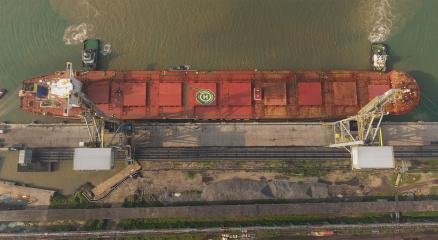
Paradip Port Authority (PPA) has achieved a significant operational milestone with the successful berthing of MV Mineral Kwangyang, its first-ever Capesize vessel with a 16.5-metre draft, at Western Dock-1 (WD-1). The development marks a major step forward in the port’s deep-draft vessel handling capabilities and reinforces its position as a key maritime gateway for bulk cargo in eastern India. The 292-metre-long and 45-metre-wide vessel arrived carrying 152,702 metric tonnes of coking coal from Hay Point, Australia. Its successful berthing demonstrates Paradip Port’s growing ability to accommodate larger bulk carriers and handle substantial cargo volumes through a single vessel call. The milestone is particularly significant for the port’s logistics and cargo-handling operations, as deeper-draft capabilities allow larger vessels to carry higher volumes, potentially improving economies of scale, cargo evacuation and overall supply chain efficiency. The development also strengthens Paradip’s role in supporting India’s bulk cargo and industrial supply chains, particularly across the eastern region. Susanta Kumar Purohit, IRSEE, Chairperson, Paradip Port Authority, congratulated Team PPA and Team JPPL for their coordinated efforts in executing the landmark operation. The successful berthing underscores the port’s operational preparedness, infrastructure capabilities and focus on safely handling larger vessels. The achievement comes amid a broader infrastructure expansion programme at Paradip. Union Minister for Ports, Shipping and Waterways Sarbananda Sonowal earlier inaugurated seven major infrastructure projects worth ₹427.80 crore at PPA, marking the port’s 18.5-metre deep-draft capability and its one-millionth tree milestone. He also witnessed the signing of concession agreements for three mechanisation projects worth ₹1,580.36 crore, aimed at strengthening cargo-handling capacity, operational efficiency and reducing vessel turnaround time. Sonowal said: "The expansion of Paradip Port's capacity is not only about strengthening one port; it is about creating a growth multiplier for eastern India. With deeper drafts, modern cargo-handling infrastructure, improved connectivity and greater mechanisation, Paradip is well positioned to drive trade, logistics, industry and employment across the region and contribute to India's emergence as a globally competitive maritime economy," With deeper berthing capability, infrastructure modernisation and increased mechanisation, Paradip Port is positioning itself to handle the next generation of large vessels while supporting higher cargo throughput and more efficient maritime logistics. The latest Capesize berthing therefore represents not only an operational achievement but also another step in strengthening India’s maritime infrastructure and eastern trade gateway. 𝐒𝐭𝐚𝐲 𝐓𝐮𝐧𝐞𝐝 𝐭𝐨 CARGOCONNECT 𝐟𝐨𝐫 𝐥𝐚𝐭𝐞𝐬𝐭 𝐮𝐩𝐝𝐚𝐭𝐞𝐬!


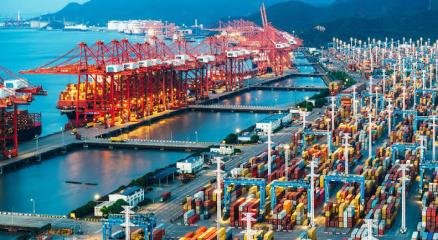
China’s Ningbo-Zhoushan Port has overtaken Singapore to become the world’s second-busiest container port during the first half of 2026, according to the latest container throughput rankings compiled by shipping analyst Alphaliner. The shift marks a notable change in the global port hierarchy, although the margin between the two gateways remains narrow. Ningbo-Zhoushan handled 22.90 million twenty-foot equivalent units (TEUs) between January and June 2026, registering an 8.8% year-on-year increase. Singapore, meanwhile, processed 22.74 million TEUs, up 4.7% from the corresponding period last year. The difference of roughly 160,000 TEUs highlights the increasingly competitive race for the second position. Shanghai retained its position as the world’s busiest container port, handling approximately 28.74 million TEUs in the first half of 2026, an increase of 6.2% year on year. The latest ranking therefore places two Chinese ports at the top, with Ningbo-Zhoushan moving ahead of Singapore for the first time over a complete six-month reporting period. Jintang Expansion Strengthens Ningbo-Zhoushan Ningbo-Zhoushan’s stronger growth has been supported by capacity expansion and improved international connectivity. The second phase of the Jintang container hub was completed in July 2026, bringing all five operational container berths within the expanded development. During the first half of the year, Jintang added 17 international shipping routes, while its container volumes increased by 23.4%. The expansion is expected to strengthen the port complex’s ability to accommodate rising cargo demand and serve an expanding network of global trade lanes. The port has experienced significant growth over the past two decades, crossing 20 million TEUs in 2015 and 30 million TEUs in 2021. In 2025, it exceeded 40 million TEUs for the first time, handling 43.87 million TEUs for the full year. Singapore remained ahead in the annual ranking, recording 44.66 million TEUs. Competition Expected to Remain Close Despite Ningbo-Zhoushan’s first-half lead, Singapore remains a formidable competitor. Alphaliner has indicated that Ningbo-Zhoushan’s growth could moderate during the second half of 2026, leaving open the possibility of Singapore reclaiming the second position. For global supply chains, the development underscores how port investments, shipping connectivity, cargo generation and changing trade patterns are reshaping the competitive landscape. With only a small volume separating the two ports, the battle for the world’s second-busiest container gateway is likely to remain closely watched through the remainder of 2026. 𝐒𝐭𝐚𝐲 𝐓𝐮𝐧𝐞𝐝 𝐭𝐨 CARGOCONNECT 𝐟𝐨𝐫 𝐥𝐚𝐭𝐞𝐬𝐭 𝐮𝐩𝐝𝐚𝐭𝐞𝐬!