
Loading...
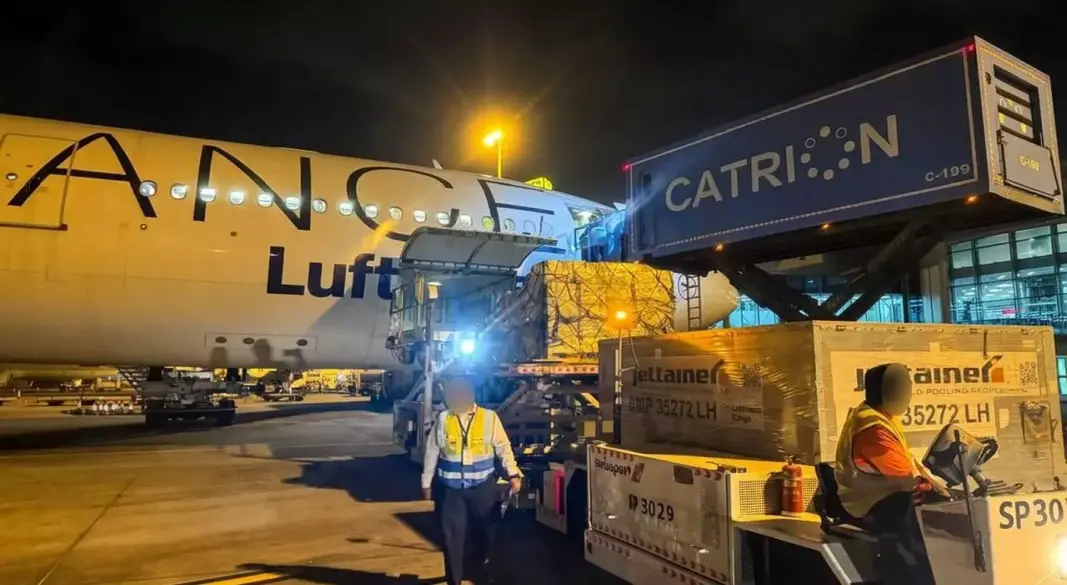
Lufthansa has resumed its Frankfurt-Riyadh passenger service, restoring additional belly-hold cargo capacity between Germany and Saudi Arabia amid strong demand for air freight. The airline restarted the route on September 10, 2026, with three weekly Airbus A340 services, with available cargo capacity reportedly fully utilised from the first day.
The renewed connection provides shippers with additional capacity between Frankfurt, one of Europe’s major air cargo gateways, and Riyadh, supporting the movement of time-sensitive and high-value shipments between Europe and Saudi Arabia. Lufthansa Cargo has highlighted the strong initial response from customers following the restoration of the service.
The resumption forms part of the Lufthansa Group’s gradual restoration of services to the Middle East following a comprehensive safety and security assessment. The group said it continues to monitor the regional security situation and remains in close contact with relevant authorities.
For the air cargo sector, the return of the Frankfurt–Riyadh service is particularly relevant because passenger aircraft belly capacity remains an important component of Lufthansa Cargo’s network. Lufthansa Cargo’s global offering combines dedicated Boeing 777F and Airbus A321F freighters with cargo capacity on passenger aircraft operated by Lufthansa and its partners.
The strong cargo uptake on the resumed Riyadh service also highlights continued demand for reliable air freight connectivity to Saudi Arabia. The development comes as the Kingdom continues to strengthen its position as a major commercial and logistics market, while Riyadh expands its role as an important gateway for international trade.
The restored connection is expected to provide exporters, importers and logistics providers with greater network flexibility, while strengthening links between the European and Saudi markets. For Lufthansa Cargo, the early utilisation levels underline the importance of restored belly capacity in meeting customer requirements across key Middle Eastern trade lanes.
𝐒𝐭𝐚𝐲 𝐓𝐮𝐧𝐞𝐝 𝐭𝐨 CARGOCONNECT 𝐟𝐨𝐫 𝐥𝐚𝐭𝐞𝐬𝐭 𝐮𝐩𝐝𝐚𝐭𝐞𝐬!

MSN Air Service LLC (MSN), a New York-based aviation and cargo handling company operating at John F Kennedy International Airport (JFK), has signed a memorandum of understanding (MoU) with Kalé Info Solutions to deploy its GALAXY cargo handling platform as the standard technology system across all new stations established as part of its international expansion. Announced at The International Air Cargo Association (TIACA) Air Cargo Forum in Miami, the agreement comes as MSN expands beyond its JFK base, with a new operational station at Cheddi Jagan International Airport in Guyana. Under the MoU, GALAXY will continue to be used at JFK and will be deployed at every new MSN station, providing a common digital platform to support operational consistency, visibility and scalability across its expanding network. GALAXY integrates import, export and transfer operations within a single cargo handling system, enabling handlers to monitor terminal activities while reducing manual processes and reliance on disconnected systems. Manoj Singh, Group Chief Executive Officer, MSN Air Service, said the company’s international growth strategy is centred on building a future-ready business through technology investments and stronger operational capabilities. He added that adopting GALAXY across its network would help establish a common technology foundation as MSN enters new markets. Amar More, Chief Executive Officer and Co-Founder, Kalé Info Solutions, said a standardised technology platform could help manage the operational complexity associated with international expansion. He noted that consistent workflows, real-time visibility and comparable performance data across locations would allow handlers to scale operations without rebuilding processes at each new station. The partnership reflects MSN’s approach of integrating technology into its expansion plans from the outset, with GALAXY intended to provide a consistent digital foundation for its international cargo handling operations.


Etihad Cargo, the cargo and logistics arm of Etihad Airways, has signed a Memorandum of Understanding (MoU) with the Virginia Economic Development Partnership (VEDP) to strengthen international air cargo connectivity and support aviation-related trade. The agreement was signed at the International Air Cargo Association’s (TIACA) Air Cargo Forum 2026 in Miami Beach, Florida. The partnership establishes a framework for exchanging market intelligence, exploring joint initiatives and identifying opportunities to expand air cargo and passenger activity. It also supports Virginia’s strategy to develop Washington Dulles International Airport (IAD) as a competitive global air cargo gateway. The collaboration will focus on meeting the logistics requirements of high-value and time-sensitive industries, including pharmaceuticals, perishables, energy, data centres and cloud computing. These sectors rely on dependable international air connectivity to facilitate trade, attract investment and support business growth. Etihad Cargo’s specialised handling capabilities are expected to complement Virginia’s ambitions. Its PharmaLife service supports pharmaceutical shipments, while FreshForward caters to perishable goods. Both products address the transportation requirements of temperature-sensitive cargo. The carrier also offers capabilities for handling high-value, time-critical and other specialised shipments across its global network. Stanislas Brun, Chief Cargo Officer at Etihad Airways, highlighted the specialised logistics demands of Virginia’s industries and said the agreement would provide opportunities to exchange expertise and explore ways to improve international connectivity through Washington Dulles. Eric Jehu, Vice-President of Logistics at VEDP, emphasised the wider economic benefits of air cargo infrastructure, noting its role in enabling investment and connecting businesses with global markets. The MoU reflects a shared focus on strengthening trade links through strategic collaboration and improved cargo connectivity. By combining Etihad Cargo’s international network and specialised logistics expertise with Virginia’s economic development objectives, the partnership aims to create new opportunities for businesses and reinforce Washington Dulles’ role in global supply chains. 𝐒𝐭𝐚𝐲 𝐓𝐮𝐧𝐞𝐝 𝐭𝐨 CARGOCONNECT 𝐟𝐨𝐫 𝐥𝐚𝐭𝐞𝐬𝐭 𝐮𝐩𝐝𝐚𝐭𝐞𝐬!


IATA data shows international air cargo demand growing 8.6% year-on-year, while jet fuel prices climb 103.4%, putting pressure on airline profitability despite stronger global trade. Global air cargo demand increased by 7.7% year-on-year in September 2026, supported by stronger international trade and manufacturing activity, according to the latest figures released by the International Air Transport Association (IATA). International air cargo demand recorded even stronger growth of 8.6% compared with September 2025. However, the industry continued to face significant cost pressures, with jet fuel prices more than doubling over the year. Global cargo capacity, measured in available cargo tonne-kilometres (ACTK), expanded by 2.7% during September, while international capacity increased by 3.3%. Demand therefore continued to outpace available capacity, lifting the global cargo load factor by 2.2 percentage points to 47.9%. Fuel prices put pressure on airline profitability Marie Owens Thomsen, IATA's Senior Vice President Sustainability and Chief Economist, said air cargo demand had grown across all regions, supported by stronger global trade and manufacturing. She also highlighted the contribution of artificial intelligence-related shipments, which helped drive another month of double-digit growth across the Pacific. However, rising fuel prices remain a major challenge for the industry. Jet fuel prices increased by 17.5% month-on-month in September and were 103.4% higher than a year earlier. IATA noted that cargo yields have not kept pace with the increase in fuel prices. Its September market analysis showed cargo yields rising by 25.9% year-on-year, compared with the 103.4% increase in jet fuel prices. The disparity highlights the growing difficulty airlines face in maintaining profitability despite stronger cargo volumes. Global trade and manufacturing support demand Several economic indicators provided a supportive backdrop for air freight activity. Global trade increased by 3.6% year-on-year in August, marking the 42nd consecutive month of annual expansion. Manufacturing activity also improved. The Global Manufacturing Output Purchasing Managers' Index (PMI) increased by 0.7 points to 53.8, while the New Export Orders Index rose by 0.5 points to 51.9. Both indicators reached their highest levels in five years, signalling improved manufacturing conditions and continued support for international cargo demand. North America leads regional growth Air cargo demand increased across all six major airline regions in September, although the pace of expansion varied. North American carriers recorded the strongest growth, with demand increasing by 11.8% year-on-year, while capacity expanded by just 0.8%. Asia-Pacific airlines reported 8.6% demand growth and a 4.9% increase in capacity, reflecting continued strength in regional and trans-Pacific cargo movements. Latin American and Caribbean carriers recorded demand growth of 6.7%, alongside a 7.6% capacity expansion. African airlines saw demand rise by 4.7%, while capacity contracted by 1.2%. European carriers recorded a 4.5% increase in demand despite a 1.6% decline in capacity. Middle Eastern airlines reported the slowest regional demand growth, at 3.8%, while capacity increased by 7%. Asia–North America remains the strongest trade lane Performance across major international trade lanes remained mixed in September. The Asia–North America corridor recorded the strongest growth, with cargo traffic increasing by 17% year-on-year. This marked eight consecutive months of expansion on the route. Traffic within Asia grew by 10.2%, while Europe–North America increased by 9.3%. Europe–Asia recorded growth of 6%, extending its expansion streak to 43 consecutive months. Africa–Asia traffic increased by 2.6%. In contrast, Middle East-connected trade lanes remained under pressure. Cargo traffic between Europe and the Middle East declined by 18%, while the Middle East–Asia corridor contracted by 10.2%. Both routes recorded seven consecutive months of decline. Demand growth faces a cost challenge The September figures underline the resilience of the global air cargo market, with demand expanding faster than capacity and manufacturing indicators remaining supportive. However, higher fuel prices and the gap between operating costs and cargo yields are creating challenges for airlines seeking to convert stronger volumes into improved financial performance. For carriers, forwarders and cargo owners, the balance between demand, available capacity and fuel expenditure will remain central to market conditions in the coming months. The latest IATA data points to a growing air cargo market, but sustaining profitable growth will depend on how effectively the industry manages rising operating costs. Follow CARGOCONNECT for more such updates