
Loading...
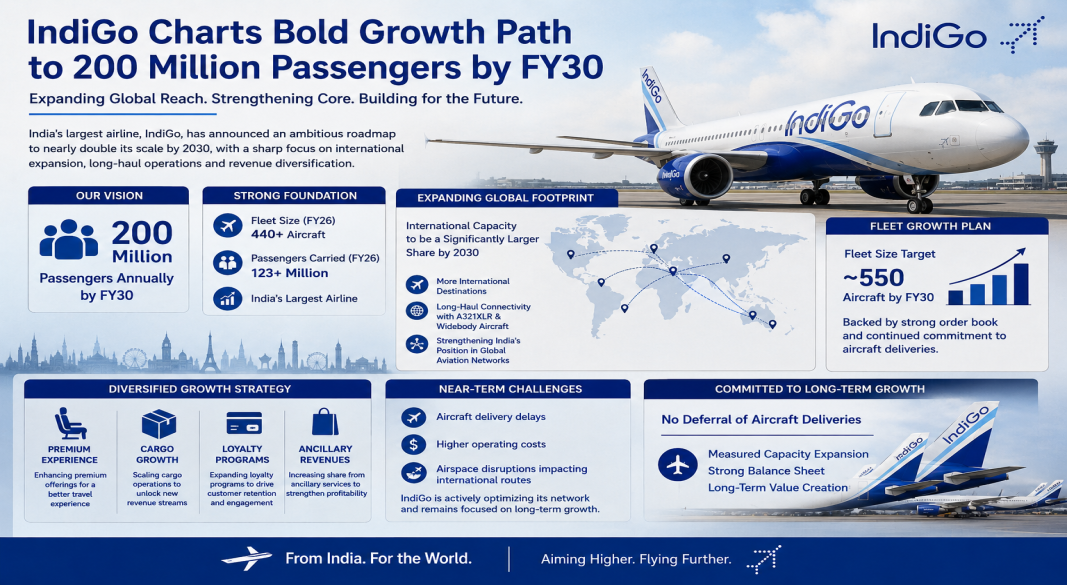
IndiGo has outlined an ambitious growth roadmap for the next four years, aiming to carry 200 million passengers annually by FY30 while significantly expanding its international network and long-haul operations. The strategy marks a shift in the airline's growth focus as it seeks to increase its presence in overseas markets and diversify revenue streams.
India's largest airline plans to nearly double its scale by the end of the decade, supported by fleet expansion, the induction of long-range aircraft and a larger share of international capacity. The carrier currently operates a fleet of more than 440 aircraft and transported over 123 million passengers during FY26.
A key element of the airline's strategy is the expansion of international services. IndiGo expects overseas operations to account for a substantially larger share of its total capacity by 2030, supported by the deployment of Airbus A321XLR aircraft and future widebody operations. The airline believes long-haul connectivity will open access to new markets and strengthen India's position in global air travel networks.
Alongside network growth, IndiGo plans to strengthen its premium travel offerings and increase contributions from cargo, loyalty programmes and ancillary services. The airline views these segments as important sources of future revenue growth beyond its traditional low-cost passenger business.
The expansion blueprint comes despite near-term challenges facing the carrier, including aircraft delivery delays, higher operating costs and ongoing airspace disruptions affecting some international routes. In recent weeks, IndiGo announced temporary suspensions on several overseas services as part of network optimisation measures.
The airline, however, has indicated that it does not intend to defer aircraft deliveries and remains committed to its long-term fleet growth plans. By FY30, IndiGo is targeting a fleet of around 550 aircraft while maintaining a measured approach to capacity expansion. As competition intensifies across domestic and international markets, IndiGo's strategy reflects a broader effort to evolve from a predominantly domestic low-cost carrier into a larger global aviation player with a stronger international footprint and diversified business model.
Follow CARGOCONNECT for more such updates.
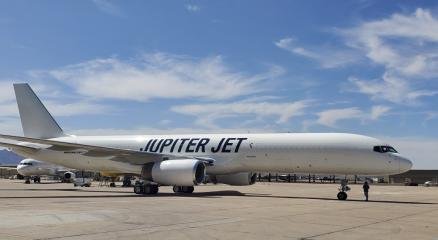
Kazakhstan-based cargo airline Jupiter Jet is rebuilding its operations with the addition of a leased Boeing 757-200 passenger-to-freighter (P2F) aircraft from AerSale, marking an important step in the carrier’s plans to expand its regional and international freight network. The Boeing 757-200PCF is Jupiter Jet’s first aircraft as it resumes operations and is expected to support cargo services across Central Asia and neighbouring markets. The aircraft offers a combination of payload capability, operating economics and range, making it suitable for express cargo and e-commerce networks, particularly across the region. The addition of the freighter strengthens Jupiter Jet’s fleet and provides the carrier with increased operational flexibility as demand for reliable air cargo capacity continues to grow. Jupiter Jet serves Kazakhstan and surrounding markets, offering freight solutions across Central Asia and beyond. “We are pleased to support Jupiter Jet’s fleet expansion with this Boeing 757 freighter,” said Craig Wright, Senior Vice President and Head of Asset Management at AerSale. “The 757 remains one of the industry’s most versatile and dependable medium-haul freighters, and this lease demonstrates AerSale’s ability to provide tailored fleet solutions that help operators meet evolving market demand,” he added. For Jupiter Jet, the aircraft is expected to provide the performance and economics required to develop its expanding cargo network. The airline has retained its air operator certificate during its period of suspended operations and is now using the Boeing 757 to rebuild its presence in the regional freight market. “We are excited to add the Boeing 757 freighter to our fleet through our partnership with AerSale,” said Erik Kozbagarov, Chief Executive Officer of Jupiter Jet. “The aircraft’s performance and economics make it an excellent fit for our expanding cargo network, allowing us to better serve our customers while positioning Jupiter Jet for continued growth,” he added. The lease also adds another Boeing 757 freighter to AerSale’s growing Central Asian cargo portfolio, following its earlier agreement with Tashkent-based Stratos Freight for a Boeing 757-200 Precision Converted Freighter. AerSale’s aircraft leasing platform supports operators worldwide with fleet solutions backed by capabilities spanning aircraft and component maintenance, repair and overhaul (MRO), engine solutions, used serviceable material (USM) and asset management. 𝐒𝐭𝐚𝐲 𝐓𝐮𝐧𝐞𝐝 𝐭𝐨 CARGOCONNECT 𝐟𝐨𝐫 𝐥𝐚𝐭𝐞𝐬𝐭 𝐮𝐩𝐝𝐚𝐭𝐞𝐬!




Airbus is set to take a major step in the development of its next-generation freighter, with the A350F scheduled to make its maiden flight on 29 September 2026 from Toulouse, France. The first flight marks a significant milestone for Airbus as it seeks to strengthen its position in the large widebody freighter market. The flight is scheduled for 10:20 a.m. local time in Toulouse and is expected to be broadcast live by Airbus. However, the manufacturer has stated that the event remains subject to operational requirements and weather conditions. The first flight-test aircraft, MSN700, registered F-WXLD, has been undergoing final ground preparations. On 24 September, the aircraft completed two high-speed rejected-takeoff tests at Toulouse, supporting preparations for its transition to flight testing. The A350F is a purpose-built freighter derived from the A350 family. Its configuration combines the forward fuselage of the A350-900 with the rear fuselage and wings of the larger A350-1000, creating a unique aerodynamic profile that requires dedicated flight testing. Airbus plans a certification campaign involving approximately 400 flight hours across two test aircraft. MSN700 will primarily support testing of aerodynamic performance, handling characteristics and the autopilot, while the second aircraft, MSN701, will focus on systems testing, including air-conditioning and fire and smoke evaluations. Airbus has indicated that certification and first customer deliveries remain targeted for 2027. The A350F is designed for a payload of more than 110 tonnes and is intended to address growing demand for efficient, modern large freighters. Its development also comes as the air cargo industry prepares for tighter emissions requirements affecting older-generation freighter designs. With the A350F competing in the emerging new-generation widebody freighter segment alongside Boeing’s 777-8F, its maiden flight will be closely watched by airlines, cargo operators and the wider global air freight industry. 𝐒𝐭𝐚𝐲 𝐓𝐮𝐧𝐞𝐝 𝐭𝐨 CARGOCONNECT 𝐟𝐨𝐫 𝐥𝐚𝐭𝐞𝐬𝐭 𝐮𝐩𝐝𝐚𝐭𝐞𝐬!



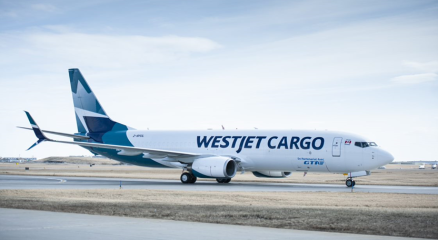
WestJet Cargo has appointed AVIAREPS as its General Sales Agent (GSA) in India, giving the aviation services company nationwide responsibility for cargo sales, customer engagement and market development. The appointment is aimed at strengthening WestJet Cargo’s commercial presence and relationships across the Indian air cargo market. Under the new mandate, AVIAREPS will represent WestJet Cargo, the cargo business of Canadian airline WestJet, across India. The company will work closely with freight forwarders, cargo agents and other industry stakeholders to support cargo sales, develop commercial relationships and identify new business opportunities. AVIAREPS will draw on its pan-India network and knowledge of the local aviation and cargo ecosystem to support WestJet Cargo’s market development objectives. The partnership combines the airline’s international cargo offering with AVIAREPS’ local sales capabilities and established industry relationships. Frederick Overton, Global Head of Cargo, AVIAREPS, said, “We are delighted to support WestJet Cargo as its Cargo GSA in India. Our pan-India presence, local market expertise and established relationships across the aviation and cargo ecosystem position us well to support WestJet Cargo’s commercial objectives in the country. We look forward to working closely with customers and industry partners across India and contributing to the continued development of WestJet Cargo’s business in this market.” The appointment forms part of WestJet Cargo’s wider GSA structure in India. Airline Services International (ASI) will work with Rainbow Aviation Private Limited to cover selected regional cargo markets, including Maharashtra, Gujarat, Telangana and Goa. For AVIAREPS, the mandate further expands its portfolio of airline cargo representation assignments and reinforces its role in providing sales, market development and customer engagement support to international carriers. For WestJet Cargo, the nationwide representation provides a dedicated local platform to engage with India’s freight forwarding and cargo community. The arrangement is expected to support the carrier’s sales activities while helping identify opportunities across one of the world’s key aviation and trade markets. 𝐒𝐭𝐚𝐲 𝐓𝐮𝐧𝐞𝐝 𝐭𝐨 CARGOCONNECT 𝐟𝐨𝐫 𝐥𝐚𝐭𝐞𝐬𝐭 𝐮𝐩𝐝𝐚𝐭𝐞𝐬!