
Loading...

Airline representation and aviation services provider Group Concorde has introduced a new corporate identity, reflecting the company's expanding international presence and broader business scope across aviation and logistics markets.
The rebranding reflects the company's transformation from a regional freight forwarding business into a diversified aviation and logistics group with operations across multiple markets. The move comes as the company strengthens its presence in Asia-Pacific, the Middle East and other international regions.
Headquartered in Gurugram, India, Group Concorde has expanded its activities beyond traditional cargo services to include airline representation, general sales and service functions, airport services and other aviation-related businesses. The company says the updated brand identity is intended to provide a unified image across its network of offices and business units.
Over the years, the organisation has established operations in several countries and built partnerships with airlines, airports and logistics stakeholders. Its growth strategy has focused on expanding service offerings while increasing its geographic reach in key aviation markets.
The refreshed branding includes a new visual identity designed to represent the company's broader scope of operations and international ambitions. The company said the change reflects its current position in the market and its plans for future growth across aviation and logistics sectors.
Industry observers note that rebranding initiatives have become increasingly common among aviation service providers seeking to consolidate multiple business lines under a single corporate identity as they expand into new markets. Group Concorde indicated that it will continue to focus on strengthening its aviation and logistics capabilities while pursuing opportunities for growth across existing and emerging markets.
Follow CARGOCONNECT for more such updates.
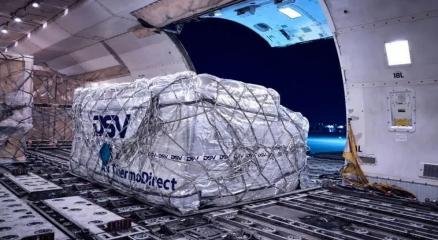
DSV is expanding its Air ThermoDirect temperature-controlled air freight network with a new direct connection between Luxembourg Airport and Shanghai Pudong International Airport (PVG), strengthening its capabilities for pharmaceutical and healthcare logistics. The logistics provider also plans to introduce an additional direct route between Indianapolis International Airport and Shanghai, further extending its Europe-US-Asia cold chain network. The new Luxembourg-Shanghai service will operate with multiple departures using dedicated freighter aircraft. According to DSV, dedicated capacity gives the company greater control over scheduling, routing and cargo handling, helping improve reliability for temperature-sensitive healthcare shipments. The expansion comes amid growing demand for secure, predictable and efficient pharmaceutical logistics worldwide. Shanghai Pudong International Airport is a key gateway for temperature-controlled pharmaceutical cargo and provides an important link between global manufacturers and healthcare markets across Asia. By expanding its operations at PVG, DSV aims to support both inbound and outbound pharmaceutical flows while maintaining consistent temperature-controlled handling throughout the transportation process. “DSV is helping customers improve supply chain efficiency, reduce operating costs, and ensure the integrity of critical healthcare products across one of the world's fastest-growing regions. Through our sustainable reusable thermal packaging program, we are reducing packaging waste and improving the environmental performance of cold chain logistics. This investment represents another important step in building a more resilient, efficient, healthcare supply chain across Asia,” says Kenneth Kallström, EVP, Global Enterprise Vertical Head, Healthcare, DSV. The Shanghai operation is supported by DSV’s partnership with Eastern Air Logistics (EAL), whose specialised ground-handling facilities will support Air ThermoDirect activities in Shanghai. China Eastern Logistics Cold Chain Ltd. will also provide dedicated cold-chain expertise and infrastructure as a ground-handling partner. A key element of the service is DSV’s use of modular thermal packaging solutions. The approach reduces reliance on active containers and conventional passive packaging, providing a more flexible, scalable and cost-efficient model for temperature-controlled air freight while maintaining pharmaceutical handling requirements. The latest expansion follows DSV’s launch earlier this year of “Indy Wings”, a direct air freight connection between Indianapolis and Luxembourg. With the addition of Shanghai connections, Air ThermoDirect is positioned to provide stronger connectivity between major pharmaceutical production, distribution and consumption markets across Europe, North America and Asia. 𝐒𝐭𝐚𝐲 𝐓𝐮𝐧𝐞𝐝 𝐭𝐨 CARGOCONNECT 𝐟𝐨𝐫 𝐥𝐚𝐭𝐞𝐬𝐭 𝐮𝐩𝐝𝐚𝐭𝐞𝐬!




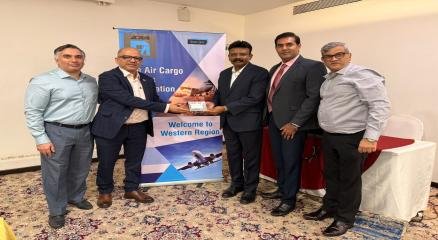
The Air Cargo Agents Association of India (ACAAI) held its Annual General Meeting at Aurika Hotel, Andheri East, Mumbai, followed by a meeting of its Managing Committee, bringing key issues shaping India’s air cargo and freight forwarding industry into focus. The AGM reviewed ACAAI’s activities and initiatives over the past year, with members deliberating on trade facilitation, regulatory developments, operational challenges, infrastructure requirements and the evolving needs of the air cargo sector. Discussions also centred on the Association’s priorities for the coming year and its continued engagement with government authorities, Customs, airlines, airport operators, custodians and other industry stakeholders. The subsequent Managing Committee meeting saw the constitution of the office-bearers for the ensuing term, with the existing leadership team continuing in office. Rajen Bhatia was elected as Honorary Secretary of ACAAI, joining President Samir J. Shah, Vice President Vikram Kumar and Honorary Treasurer Dinesh Krishnan in the Association’s leadership team. The continuity in leadership underscores ACAAI’s focus on stability and sustained industry engagement as the air cargo ecosystem navigates evolving regulatory, operational and infrastructure requirements. Representing India’s air cargo agents and freight forwarding community since 1970, ACAAI remains focused on trade facilitation, policy advocacy, professional development and addressing operational challenges affecting the sector. Looking ahead, the Association has reiterated its commitment to strengthening collaboration with Regional Councils and the wider membership, while working collectively with stakeholders to enhance the efficiency, competitiveness and ease of doing business across India’s air cargo and logistics ecosystem.


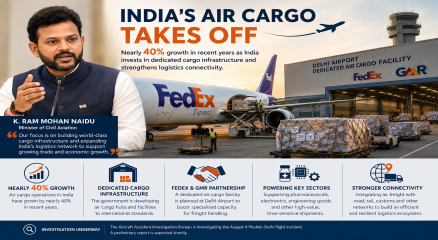
India’s air cargo operations have grown by nearly 40% in recent years, according to Civil Aviation Minister K. Ram Mohan Naidu, as the government looks to expand dedicated freight infrastructure and strengthen the country’s logistics network. Naidu said the government is working to develop air cargo hubs and facilities to international standards, reflecting the growing role of air freight in India’s wider logistics and trade infrastructure. A key development is planned at Delhi airport, where FedEx and GMR Airports have entered into a partnership to establish a dedicated air cargo facility. The project is expected to add specialised capacity for freight handling at one of India’s major aviation gateways. The increase in cargo volumes comes as India’s logistics sector handles rising demand for faster movement of high-value, time-sensitive and international shipments. Air freight is particularly important for sectors such as pharmaceuticals, electronics, engineering goods and other products where transit time is a significant consideration. The government’s focus on dedicated cargo infrastructure also points to an effort to separate freight-handling requirements from the operational demands of passenger aviation, while improving the efficiency of cargo processing and connectivity. Naidu’s comments come amid broader efforts to strengthen India’s aviation and logistics infrastructure. The government has been seeking greater integration of air transport with the country’s wider logistics network as trade and manufacturing activity expand. The reported growth in air cargo activity and planned investments in dedicated facilities indicate that freight capacity is becoming an increasingly important component of India’s aviation infrastructure. However, the effectiveness of the expansion will depend on how efficiently new cargo facilities are integrated with road, rail, customs and other parts of the supply chain. Follow CARGOCONNECT for more such updates